The Complete Guide to Storm and Wind Damage Repairs
How Storms Damage Different Roof Types
Understanding how storm damage affects different roof types helps you assess the urgency of the situation and communicate effectively with your roofer and insurer. Here is what we see on the most common roof types across the housing stock in Berkshire, Surrey and Greater London.
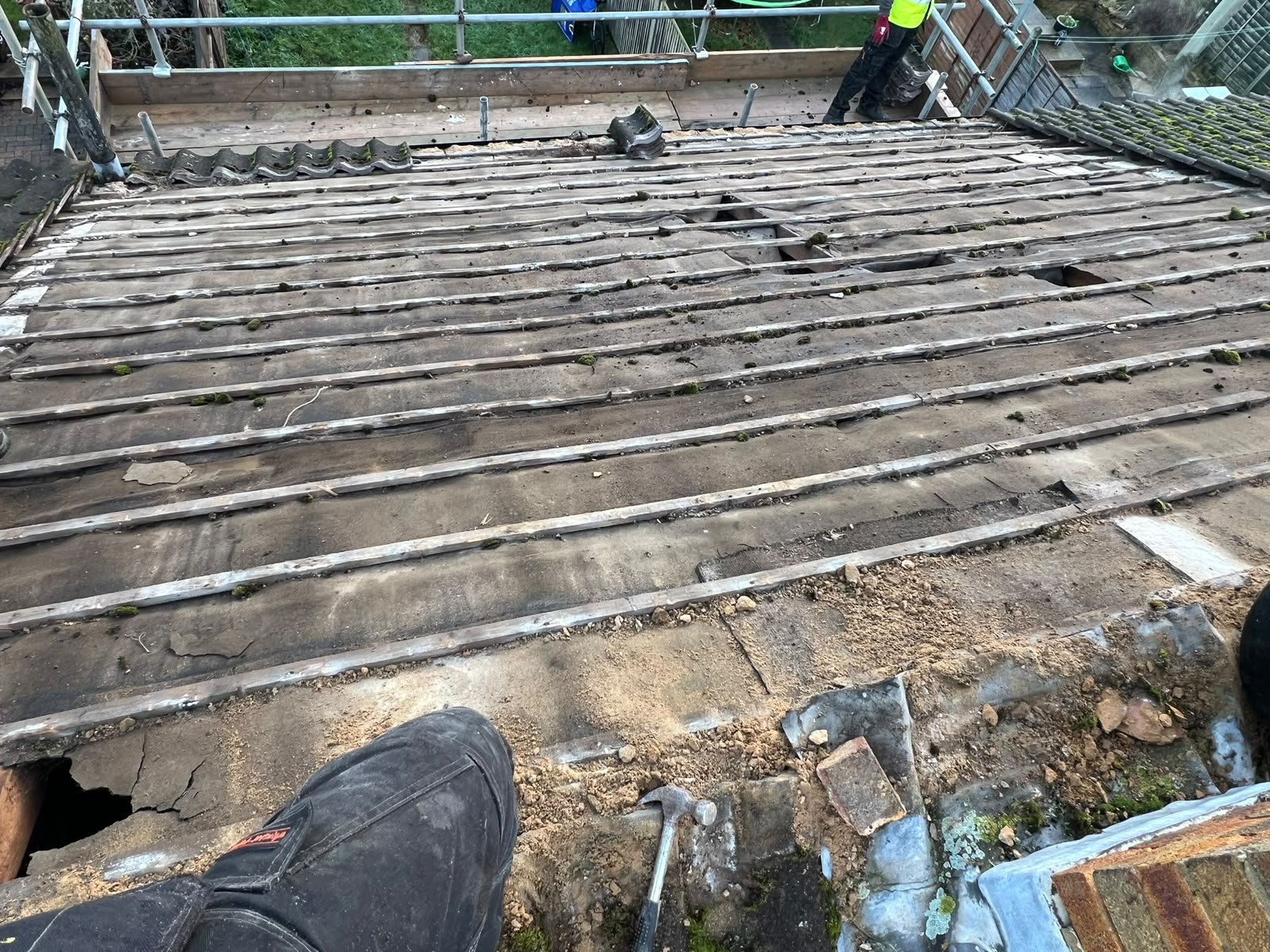
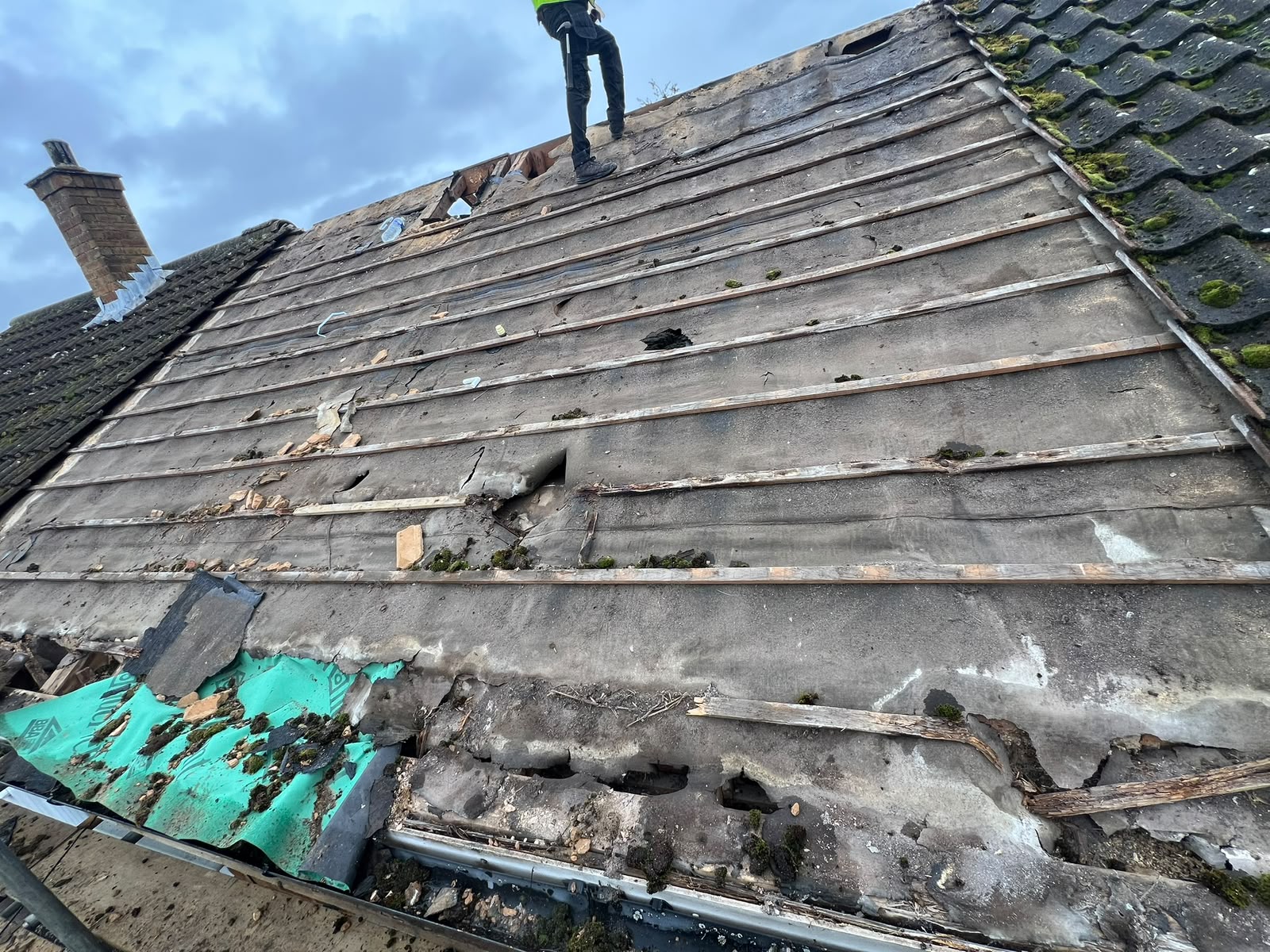
Concrete interlocking tiles (Marley Modern, Redland 49, Russell Grampian and similar) are the most common roof covering across the post-war housing in Slough, Reading, Maidenhead and the wider Thames Valley. These tiles rely on their own weight, the interlocking profile and nail fixings to resist wind lift. In high winds, the most vulnerable areas are the verge tiles (at the edges of the gable), the ridge tiles (along the top), and any tiles where the nails have corroded or the nibs are broken. When a single tile lifts, it breaks the interlock with its neighbours, which then become vulnerable. This is why storm damage to interlocking tile roofs often starts with one or two tiles and escalates rapidly as each displaced tile exposes the next. We commonly see progressive tile loss across the bottom three or four courses on the windward side of the roof, where wind uplift forces are greatest.
Natural slate roofs are common on Victorian and Edwardian properties across the older areas of Slough, Windsor and Greater London. Slates are individually nailed (or hooked) and are relatively wind-resistant when properly fixed. However, nail fatigue (where the fixing nails corrode and weaken over decades) is common on older slate roofs, and a storm often reveals the extent of the corrosion by dislodging multiple slates simultaneously. Broken slates are also common — a slate cracked by impact (from a falling branch, aerial or debris) will usually hold in place until the next strong wind lifts the broken piece out.
Flat roofs (felt, GRP, EPDM) are vulnerable to wind in a different way. Rather than individual elements being blown off, the entire membrane can be peeled back if the edge details or upstands are compromised. We see this most commonly where felt has aged and become brittle, or where the adhesion to the deck has failed. The wind gets under a lifted edge or a failed seam and progressively peels the covering back. On flat-roofed extensions and garages across the areas we serve, storm damage often presents as a section of felt rolled back like a carpet, exposing the deck and insulation to rain.
Ridge tiles are one of the most common casualties of storm damage across all roof types. Traditional sand-and-cement bedded ridges become vulnerable as the mortar ages and cracks, and a gust of wind can dislodge one or several ridge tiles in seconds. A dislodged ridge tile leaves the ridge beam and the top of the tile battens completely exposed to rain, which can cause rapid water damage to the roof timbers. Modern dry-ridge systems (such as Klober or Manthorpe) are significantly more wind-resistant because they use mechanical fixings rather than mortar, and we often recommend upgrading to a dry-ridge system when re-bedding storm-damaged ridges.
The Critical First 24 Hours: What to Do When Your Roof Is Damaged
The actions you take in the first 24 hours after storm damage can significantly affect the extent of secondary damage, the success of your insurance claim, and the cost of the eventual repair. Here is our step-by-step guide based on hundreds of emergency callouts across Berkshire and the surrounding area.
1. Ensure personal safety. This is the most important step and the one that people often skip in the panic of a storm. Do not go onto the roof. Do not lean ladders against a storm-damaged roof — the structure may be weakened and ladder loading could cause further collapse. Do not touch any fallen power cables or go near any debris that may have brought down power lines. If there is water coming through the ceiling, turn off the electricity at the consumer unit for the affected circuit (or the whole house if you are unsure) before entering the room. Place buckets and containers to catch drips and move furniture and valuables away from wet areas.
2. Document the damage. Before anything is moved, cleaned up or repaired, take photographs and video from as many angles as possible. Photograph the damage from outside (the roof from ground level, any visible missing tiles or displaced materials), from inside (water stains, drips, fallen debris), and any damage to the property contents. Also photograph any debris in the garden — fallen tiles, ridge caps, pieces of timber, branches. Make sure your camera records the date and time (most smartphone cameras do this automatically). This documentation is essential for your insurance claim.
3. Call your roofer. Call Dripstop Roofing on 07405 391861. We answer emergency calls seven days a week, including during and after storms. We will talk you through immediate steps over the phone, assess the urgency based on your description, and arrange a visit as quickly as possible. For active water ingress or structural damage, we aim to attend the same day. For damage that is contained (no active water entry), we will usually attend within 24 hours.
4. Call your insurance company. Notify your home insurer as soon as possible, ideally within 24 hours. Most policies require prompt notification of claims. Tell them the date and approximate time of the damage, a brief description of what has happened, and that you have instructed a roofing contractor for emergency repairs. Your insurer may ask you to obtain quotes from approved contractors, but you are legally entitled to use your own contractor — you do not have to use whoever the insurer suggests. Keep a note of the claim reference number and the name of the person you speak to.
5. Mitigate further damage. Your insurance policy almost certainly includes a duty to mitigate — meaning you are expected to take reasonable steps to prevent further damage. Calling a roofer for emergency weatherproofing fulfils this duty. The cost of emergency tarping and temporary repairs is almost always covered by the insurance claim as a reasonable mitigation measure. If you are waiting for the roofer to arrive, you can minimise internal damage by placing waterproof sheets over furniture and possessions, and by continuing to catch drips in containers.
Insurance Claims Process Explained Step by Step
Navigating a storm damage insurance claim can be stressful, particularly if you have not made a claim before. Here is how the process works in practice, and how Dripstop Roofing supports you through it.
Step 1: Notification. You notify your insurer (by phone or online) within 24 hours of discovering the damage. They will register the claim and provide a reference number. Be factual and concise in your description — state what has happened and what damage you can see, but do not speculate about causes or costs at this stage.
Step 2: Emergency repairs. We attend site, carry out emergency weatherproofing, and document all damage with date-stamped photographs. We provide you with an emergency repair invoice marked as emergency mitigation works — this is a claimable expense under virtually all home insurance policies. We also prepare a preliminary damage assessment noting all visible storm damage.
Step 3: Full assessment and quotation. Once conditions allow safe access for a thorough inspection, we carry out a detailed assessment of all storm damage. We distinguish clearly between storm damage and pre-existing wear — this distinction is critical because insurers only cover storm damage, not maintenance items. We provide a detailed written quotation for the permanent repair works, itemised so the insurer can see exactly what each element covers.
Step 4: Insurer review. Your insurer reviews our documentation and quotation. On claims under approximately 3,000 to 5,000 pounds, many insurers will settle based on the documentation alone. On larger claims, the insurer may appoint a loss adjuster to visit the property and assess the damage independently. If a loss adjuster visits, we are happy to attend the same appointment to answer technical questions and walk through our assessment. Having a knowledgeable roofer present during the loss adjuster visit significantly strengthens the claim because we can explain technical details that might otherwise be missed or misunderstood.
Step 5: Approval and repair. Once the insurer approves the claim (minus your policy excess), we schedule the permanent repair works. We carry out all repairs to our standard high specification, provide a workmanship guarantee, and supply all the completion documentation that the insurer requires to close the claim. If the insurer requests any variations or additional information at any stage, we handle this directly so you are not caught in the middle.
One important note: some insurers will try to direct you to their approved contractor network. While you are free to use these contractors, you are equally free to choose your own. We strongly recommend using a local, specialist roofer who will carry out the permanent repair to a high standard, rather than a large national claims management company that subcontracts the actual work to whoever is cheapest. As your local roofer in Berkshire, we have a reputation to maintain in the community, which is your best guarantee of quality workmanship.
Preventing Future Storm Damage to Your Roof
While you cannot control the weather, there are practical steps that significantly reduce the risk and severity of storm damage to your roof. As roofers who deal with storm damage across Berkshire, Surrey and Greater London throughout the storm season, here are our top recommendations.
Annual maintenance inspection: This is the single most effective preventative measure. A professional annual inspection identifies the weak points — cracked mortar, corroded fixings, lifted flashings, loose tiles — that are the first things to fail in a storm. Fixing these during a planned maintenance visit costs a fraction of the emergency repair after a storm. We offer annual maintenance packages specifically designed to storm-proof your roof.
Upgrade to dry-ridge systems: If your ridge tiles are bedded in sand-and-cement mortar (as most pre-2015 installations are), consider upgrading to a mechanical dry-ridge system next time the ridges need re-pointing. Dry-ridge systems use stainless steel fixings, roll-out ventilation strips and mechanical clips that provide vastly superior wind resistance compared to mortar bedding. The cost difference over traditional re-pointing is modest, and the result lasts significantly longer. Brands we recommend include Klober Uni-Click, Manthorpe and Hammerfix.
Check and replace corroded fixings: Tile nails corrode over time, particularly the galvanised steel nails used on roofs from the 1960s to 1990s. If your roof is 30 years old or more and has never been re-fixed, there is a good chance that many of the nail fixings are compromised. Stainless steel or copper nails last the life of the roof and do not corrode. A re-fix programme — carried out progressively over several maintenance visits or as a one-off project — dramatically improves the roof wind resistance.
Trim overhanging trees: One of the most common sources of storm damage we attend in the wooded areas of Berkshire and Buckinghamshire is branches falling onto roofs. Trees within falling distance of the roof should be inspected by a qualified arborist and any deadwood or structurally compromised limbs removed. This is particularly important for large deciduous trees (oaks, beeches, ash) which are prone to limb failure in high winds, and for conifers which can topple entirely in waterlogged soil.
Secure loose items: Satellite dishes, aerials, vent pipes and solar panel fixings should all be checked for security before the storm season. A satellite dish ripped off by wind can take tiles with it, creating far more damage than the dish alone. We check all roof-mounted items during our annual inspections and secure anything that is loose.
Investing in storm prevention is invariably cheaper than dealing with the consequences. If you would like a pre-storm-season roof health check, call us on 07405 391861. We carry out these assessments across Slough, Maidenhead, Windsor, Reading, High Wycombe and the wider Berkshire, Surrey and Buckinghamshire area.