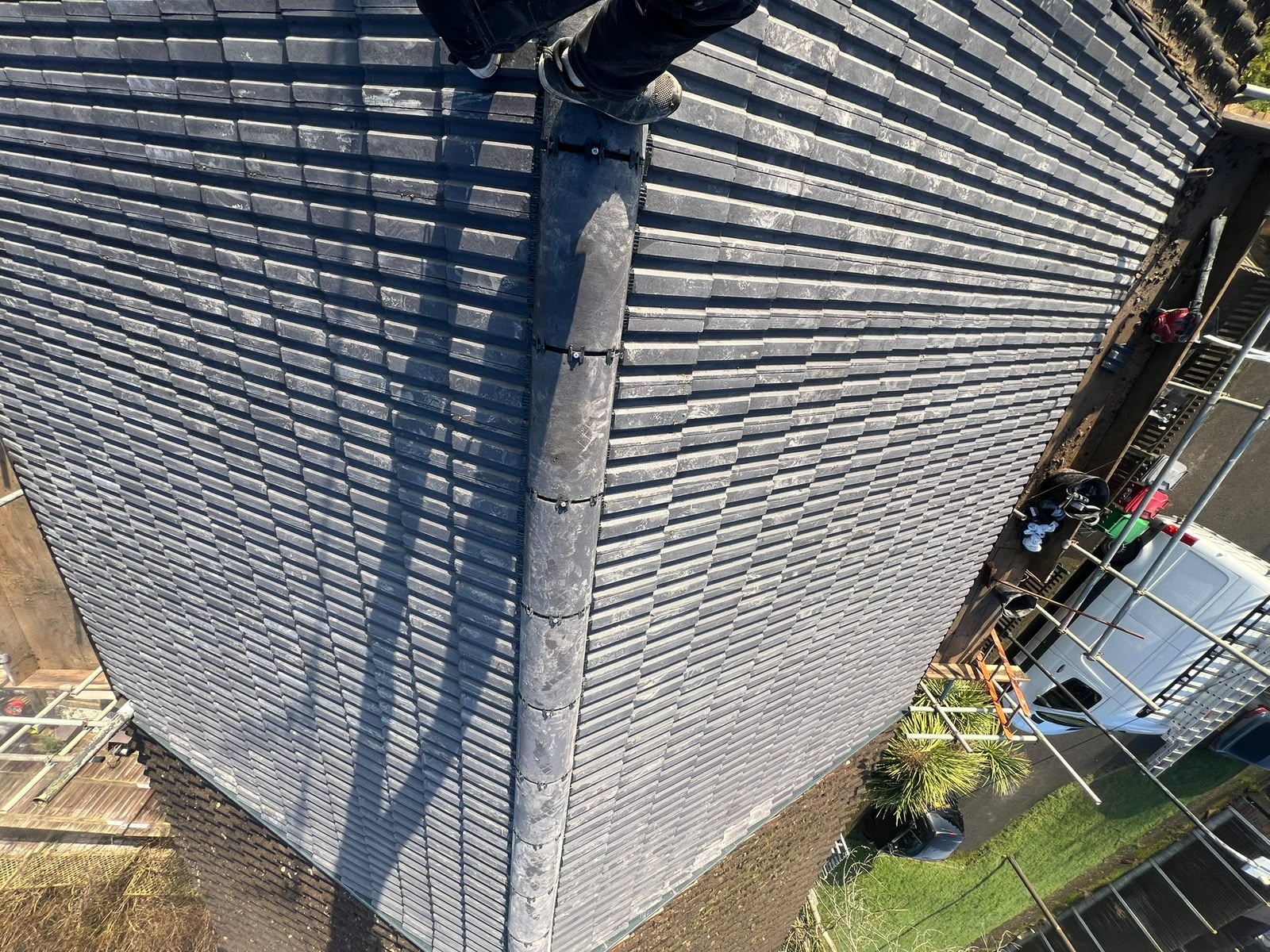
From the finest Welsh slate to traditional handmade clay tiles and modern concrete interlocking systems — we supply and install every type of pitched roof covering to the highest standard.
The choice of tile or slate on your roof defines the character of your property, affects its value, and determines how long the covering will last before it needs replacing. Get it right and you have a roof that looks stunning and lasts a lifetime. Get it wrong — wrong material for the pitch, wrong fixings for the exposure, wrong specification for the building — and you are looking at problems within years. At Dripstop Roofing, we have been installing slate and tile roofs across Slough, Reading, Windsor, Maidenhead, and the wider Berkshire area since 2020, and we know exactly which materials work best for each type of property and location.
We work with the full spectrum of pitched roofing materials: natural Welsh slate from the Penrhyn and Ffestiniog quarries; Spanish and Brazilian slate; handmade and machine-made clay tiles from manufacturers including Dreadnought, Sahtas, and Marley; and concrete interlocking and plain tiles from Marley, Redland, Forticrete, and Russell. Every installation complies with BS 5534:2014+A2:2018 for slating and tiling, and we are experienced in working within conservation areas where specific material specifications are required by the local planning authority.
Whether you need a complete re-roof in natural slate, a tile replacement on a period property, or a new roof on an extension that needs to match the existing covering exactly, our team has the skills and material knowledge to deliver an exceptional result. We serve homeowners across Berkshire, Surrey, Buckinghamshire, and Greater London.
Get a Free Quote
What We Offer
Welsh, Spanish, and Brazilian slate — sourced from reputable quarries with full BBA certification. Head-nailed or centre-nailed to BS 5534, with proper gauging for the slate size and roof pitch.
Handmade and machine-made clay tiles in plain, pan, and interlocking profiles. From Dreadnought Staffordshire Blues to Marley Ashdowne — we match the right clay tile to your property's character and period.
Marley, Redland, Forticrete, and Russell concrete interlocking and plain tiles. The modern workhorse of UK roofing — durable, cost-effective, and available in a wide range of profiles and colours.
Matching discontinued or reclaimed tiles for repairs and extensions. We source from specialist reclamation yards and can identify obscure tile profiles from a photograph or sample.
Experience working within conservation areas in Windsor, Ascot, and Historic Berkshire where specific slate or tile materials, profiles, and colours are required by planning conditions.
Mechanical dry-fix ridge and hip systems from Redland, Klober, and Manthorpe — no mortar to crack or crumble, ventilated, and guaranteed for 25+ years.
Natural slate and artificial (man-made or fibre cement) slate may look similar from the ground, but they are fundamentally different materials with very different characteristics, lifespans, and costs. Understanding the differences will help you make the right choice for your property.
Natural slate is a metamorphic rock, quarried in sheets and split to thickness. The finest natural slates — Welsh slate from Penrhyn (Bangor Blue) or Ffestiniog (Cwt-y-Bugail) — are among the most durable roofing materials on earth, with a proven lifespan of 150-200+ years. They are virtually non-porous, resistant to freeze-thaw cycling, and maintain their appearance indefinitely. Welsh slate carries an S1 rating under BS EN 12326 (the lowest water absorption category) and a T1 thermal cycling resistance. It is, quite simply, the finest roofing slate available anywhere.
Spanish slate (typically from quarries in the Galicia region) offers excellent value at roughly 50-65% of the cost of Welsh slate. Good-quality Spanish slate — sourced from SIGA-certified quarries with full BBA or BRE certification — can last 80-100+ years and performs admirably in the UK climate. However, quality varies enormously between quarries. Cheap, uncertified Spanish slate (often found on budget new-builds) can delaminate, rust (due to iron pyrite inclusions), and fail within 20-30 years. We only source from quarries we have personally vetted.
Artificial slate — products like SSQ Riverstone, Marley Edgemere Slate, or fibre cement slates from Cembrit and Eternit — are manufactured to look like natural slate but are made from concrete, fibre cement, or recycite composites. They are lighter, cheaper, and more uniform than natural slate, with a typical lifespan of 40-60 years. They are a perfectly respectable choice for modern properties and extensions, but they do not carry the prestige, longevity, or character of genuine natural slate. In conservation areas, artificial slates are often not accepted by the planning authority.
Clay roofing tiles have been used on British buildings for over 700 years, and they remain one of the finest roofing materials available. Modern clay tiles combine centuries-old tradition with advanced manufacturing techniques to produce a product that is beautiful, durable, and exceptionally long-lasting.
There are three main types of clay roof tile used in the UK. Plain tiles (also called flat tiles or peg tiles) are the traditional rectangular tile — approximately 265mm x 165mm — that has been used since medieval times. They are double-lapped (each point on the roof is covered by at least two tiles), which provides excellent weather protection but requires a steep pitch (minimum 35 degrees) and uses a lot of tiles — approximately 60 per square metre. Handmade plain tiles from manufacturers like Dreadnought, Sahtas, and Keymer have a beautiful, irregular texture with subtle colour variations that machine-made tiles cannot replicate. They weigh around 75 kg/m2, so the roof structure must be adequate to support them.
Interlocking clay tiles — such as the Sandtoft 20/20 or Wienerberger Actua — have a single lap with interlocking side joints, meaning fewer tiles per square metre and a lighter overall weight. They are suitable for pitches from 17.5 degrees upwards and offer a more modern appearance. They are particularly popular for extension roofs where a clay finish is desired but the structure cannot support the weight of traditional plain tiles.
Pan tiles (also called pantiles or S-tiles) are a distinctive curved profile most commonly seen in eastern England. In Berkshire, they are less common but occasionally required for heritage properties. Modern reproductions from Sandtoft and Imerys closely match the traditional profiles.
Concrete interlocking tiles account for the majority of residential roofs installed in the UK over the past 50 years, and for good reason — they offer an excellent balance of durability, aesthetics, and value. Modern concrete tiles bear little resemblance to the grey, characterless products of the 1960s and 70s. Today's ranges from Marley, Redland, Forticrete, and Russell come in a wide variety of profiles, textures, and colours that can complement any property style.
The most popular concrete tile profiles we install across Berkshire include: Marley Edgemere (a slim-line, flat interlocking tile with a contemporary appearance), Marley Modern (the UK's best-selling roof tile — a bold, granular-textured interlocking tile), Redland 49 (a versatile interlocking tile with a smooth or granular finish), Redland Mini Stonewold (a smaller-format tile that replicates the appearance of natural stone slate), and Forticrete Centurion (a large-format, lightweight interlocking tile for fast, economical installation).
Concrete tiles typically last 50-60 years. They are heavier than artificial slate but lighter than clay plain tiles, making them suitable for most standard roof structures without modification. They achieve their colour through a through-body pigmentation or surface coating process — through-coloured tiles maintain their appearance better over time, while surface-coated tiles may fade somewhat after 15-20 years. All concrete tiles we install are mechanically fixed to BS 5534 using appropriate clips and nails for the wind exposure zone — which in Berkshire and the Thames Valley is typically Zone 2 or Zone 3.
One of the most common challenges in roofing is matching the existing tiles on a property when carrying out repairs, building an extension, or replacing a damaged section. This is an area where experience and material knowledge make the difference between a seamless result and an obvious mismatch that devalues your property.
For common, currently-manufactured tiles — Marley Modern, Redland 49, Marley Ludlow Major — matching is straightforward as long as you get the colour right. New tiles will look slightly different from weathered ones initially, but they blend within 2-3 years. We always recommend installing new tiles on the less visible elevation and moving weathered tiles to the front if a close match is critical in the short term.
For discontinued tiles, matching requires detective work. We maintain a database of tile profiles and can usually identify an unknown tile from a photograph or physical sample. Sources include specialist reclamation yards (such as BJ Salvage in Berkshire and Heritage Reclamation in Surrey), salvage from demolition sites, and occasionally the manufacturer's own legacy stock. When a like-for-like match is impossible, we recommend the closest modern equivalent and discuss with you whether a full re-tile of the visible elevation is preferable to a noticeable mismatch.
For conservation areas in Windsor, Ascot, and parts of Greater London, matching existing materials is often a planning requirement, not just an aesthetic preference. We work closely with local planning officers and conservation teams to ensure our material choices meet the requirements of listed building consents and conservation area regulations.
How It Works
We visit your property, assess the existing roof and structure, discuss your requirements and budget, and recommend the most appropriate slate or tile system for your project.
We source your chosen materials — including matching existing tiles if required — arrange scaffolding, and schedule the work at a time that suits you.
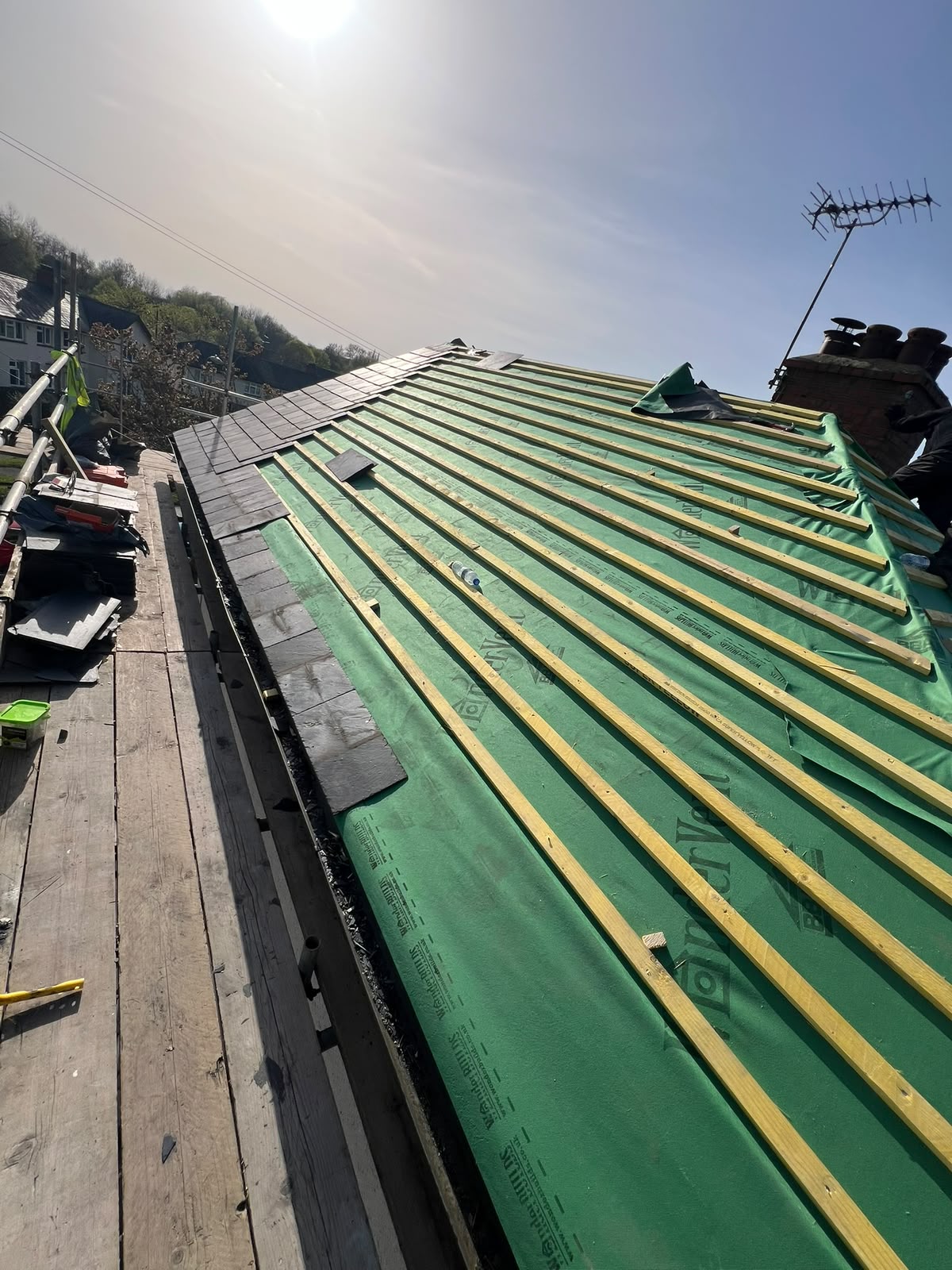
Our team installs your new roof covering to BS 5534, with proper mechanical fixing, correct batten gauge, and meticulous detailing of ridges, hips, valleys, and flashings.
We carry out a final quality check, arrange building control sign-off if required, clean up, and hand over your manufacturer warranty and workmanship guarantee documents.
Slate and tile roofing costs vary significantly depending on the material chosen, the size and complexity of the roof, and the condition of the existing structure. Below are typical price ranges for a standard 3-bedroom semi-detached property in Berkshire. Natural slate commands a premium but offers the longest lifespan and highest property value uplift. All prices include labour, materials, scaffolding, waste disposal, and VAT.
| Service | Typical Cost | Timeframe |
|---|---|---|
| Natural Welsh slate roof (3-bed semi) | £12,000 – £22,000 | 7–12 days |
| Spanish slate roof (3-bed semi) | £9,000 – £16,000 | 7–10 days |
| Clay plain tile roof (3-bed semi) | £8,000 – £15,000 | 7–10 days |
| Concrete interlocking tile roof (3-bed semi) | £5,000 – £10,000 | 5–7 days |
| Tile or slate repair (1-10 units) | £150 – £500 | Half day |
Prices are estimates based on typical UK projects in 2024–2025. Actual costs vary by property size, access, materials, and location. We provide free, detailed quotes.

Slate and tile roofing is a craft as much as a trade. The difference between an average installation and an exceptional one lies in the details — consistent gauge lines, tight-fitting slates with minimal shoulder gaps, properly dressed lead valleys, ridge tiles that follow the roof line rather than fighting it. At Dripstop Roofing, we take genuine pride in the quality of our slating and tiling work. Every tile is placed with care, every cut is clean, and every detail is finished to a standard we would want on our own homes.
We have been installing slate and tile roofs across Berkshire, Surrey, Buckinghamshire, and Greater London since 2020, and our portfolio includes everything from simple concrete re-roofs on modern semis to full Welsh slate installations on period properties in conservation areas. Whatever material you choose, you can trust that it will be installed correctly, fixed securely, and guaranteed comprehensively.
Call us on 07405 391861 or complete our contact form for a free consultation and detailed quotation. We are happy to bring tile and slate samples to your property so you can see the materials in the context of your home before making a decision.
Common Questions
Welsh slate is the most durable roofing material available, with a proven lifespan of 150-200+ years. Spanish slate from reputable quarries typically lasts 80-100+ years. Even the shortest-lived natural slate will outlast any other roofing material by decades. The key is sourcing quality slate from certified quarries — cheap, uncertified slate can fail within 20-30 years due to iron pyrite inclusions and excessive porosity.
For period properties, conservation areas, and homes where longevity and aesthetic quality are priorities, natural slate is an excellent investment. A Welsh slate roof installed today could still be performing perfectly for your grandchildren. The cost premium over concrete tiles is significant (roughly 2-3x), but amortised over the roof's lifespan, the annual cost is actually lower. Natural slate also adds measurably to property value — estate agents consistently report that slate-roofed homes achieve higher sale prices.
In most cases, yes. We carry stock of the most common tile profiles and can source discontinued tiles from specialist reclamation suppliers, typically within a week. We can identify most tiles from a photograph. If an exact match is impossible, we recommend the closest modern equivalent and discuss strategies like relocating weathered tiles to the visible elevation. For conservation area properties, we work with the planning authority to ensure compliance.
Clay tiles are kiln-fired from natural clay, giving them a rich colour that never fades and a lifespan of 80-100+ years. They are heavier and more expensive than concrete. Concrete tiles are made from cement, sand, and water with added pigments, offering a lifespan of 50-60 years at roughly 40-50% less cost. Both are excellent materials — the choice depends on your budget, aesthetic preference, and whether planning requirements dictate a specific material.
Yes. We have extensive experience working within conservation areas in Windsor, Ascot, and Historic Berkshire, as well as listed buildings across the Home Counties. We understand the planning constraints, know which materials are typically required, and can advise on applications for listed building consent or conservation area approval. We source reclaimed and heritage materials from trusted suppliers to meet even the most exacting planning conditions.
Minimum pitch requirements vary by material: natural slate typically requires a minimum of 20 degrees (some sizes down to 17.5), concrete interlocking tiles 17.5-22.5 degrees depending on the profile, and clay plain tiles 35 degrees minimum. These are BS 5534 minimums — steeper pitches provide better weather resistance. We always check the pitch during our survey and will advise if your roof is marginal for your chosen material.
BS 5534:2014+A2:2018 requires mechanical fixing of every tile on new and re-roofed properties — a significant change from the old practice of only nailing every fourth or fifth course. We fix tiles using a combination of nails and clips appropriate to the wind exposure zone (Berkshire is typically Zone 2-3). Ridge and hip tiles are fixed using dry-fix mechanical systems from Redland or Klober, eliminating mortar that can crack and fail.
Yes, but there are structural considerations. Natural slate is heavier than concrete interlocking tiles (particularly Welsh slate at approximately 55-65 kg/m2 vs 42-48 kg/m2 for concrete interlocking), so we need to verify that your roof structure can support the additional weight. This may require a structural engineer's assessment. Planning permission may also be needed if the change significantly alters the property's appearance. We handle the entire process including structural checks and planning advice.
Get Started
Contact Dripstop Roofing today for a free, no-obligation quote. Call us on 07405 391861 or fill in our online form.
Get Free Quote