The Complete Guide to Choosing and Installing Skylights
Velux vs Fakro vs Keylite: An Honest Comparison
These are the three main roof window manufacturers available in the UK, and homeowners regularly ask us which one to recommend. After installing hundreds of units from all three brands across properties in Berkshire, Surrey and Greater London, here is our honest assessment based on real-world performance.
Velux is the market leader and the name most people use generically (much like Hoover for vacuum cleaners). Their product range is extensive, the quality is consistently excellent, and the flashing kits are engineered precisely for UK tile and slate profiles. The GGU (white polyurethane centre-pivot) and GPU (white polyurethane top-hung) ranges are our most commonly installed units. Velux windows come with a 10-year manufacturer guarantee, parts availability is excellent, and every roofing merchant in Slough, Reading and the surrounding area stocks them. If you have no strong preference, Velux is the safe, proven choice.
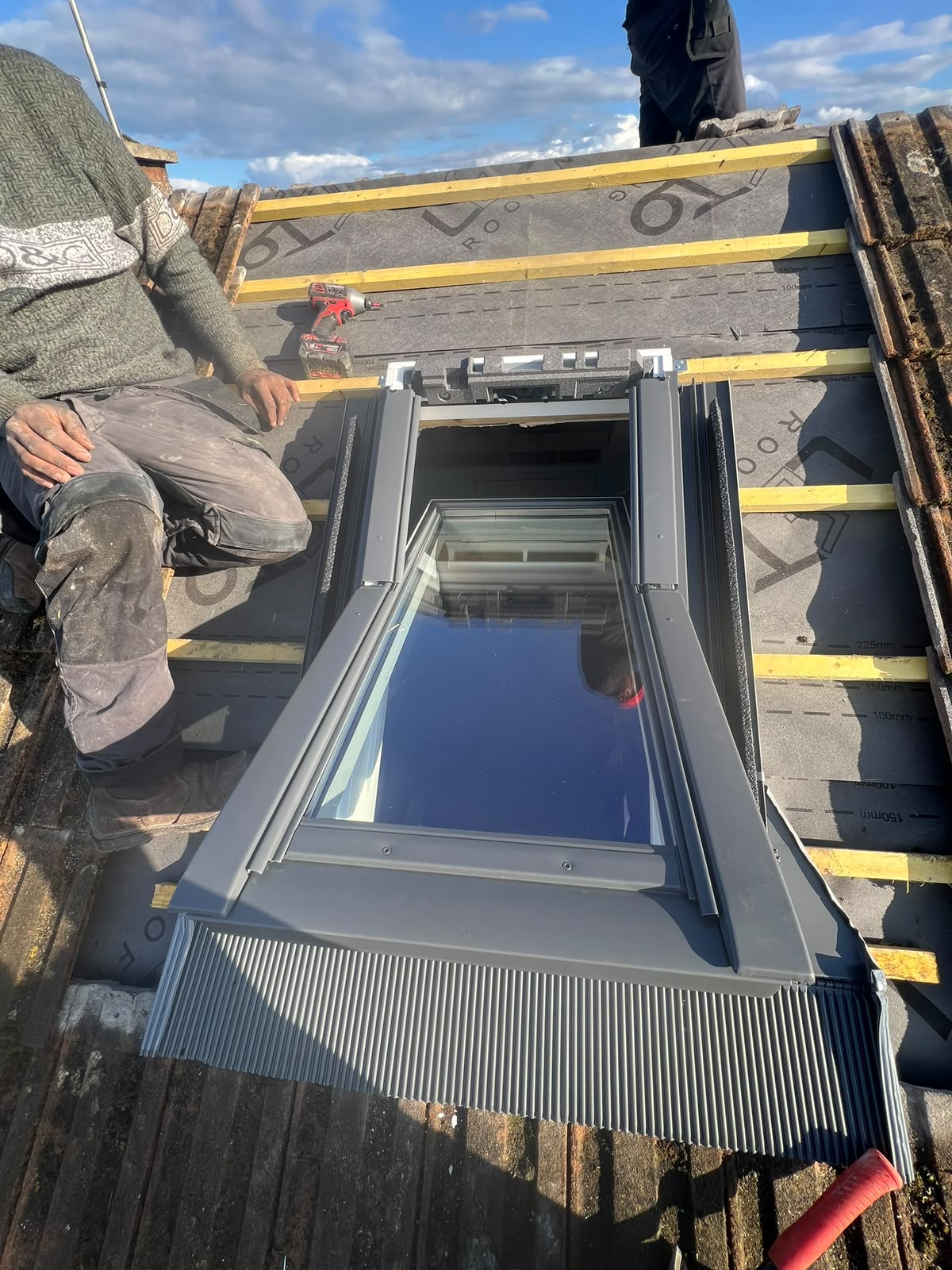
Fakro is a Polish manufacturer that has gained significant market share in the UK over the past decade. Their windows are typically 10-15% cheaper than equivalent Velux units, and the build quality is genuinely good. The FTP-V range is their equivalent of the Velux GGU, and the FPP-V is their top-hung option. Where Fakro falls slightly behind is in flashing kit precision — we find the Velux EDJ and EDW kits integrate more cleanly with UK interlocking tiles like Marley Modern and Redland 49. That said, for budget-conscious projects, Fakro represents excellent value and we install them regularly without any concerns about long-term performance.
Keylite is an Irish manufacturer with a clever integrated flashing system that simplifies installation. The flashing is built into the window frame rather than being a separate kit, which reduces the number of components and can speed up fitting. We have installed Keylite units on several projects across Buckinghamshire and they perform well. The main limitation is range — Keylite offers fewer size options than Velux or Fakro, and the availability through local merchants in the Berkshire area is more limited, which can affect lead times.
Our recommendation: for most residential installations across the areas we cover, Velux offers the best combination of quality, range, availability and long-term support. For cost-sensitive projects where the window will not be in a prominent position, Fakro is a strong alternative. We are happy to quote for any brand and will always explain the trade-offs honestly.
Choosing the Right Size and Position for Your Skylight
Getting the size and position right is arguably more important than the brand of window you choose. A skylight that is too small will not deliver the light levels you expect; one that is too large may overheat the room in summer and create excessive heat loss in winter. Here are the practical guidelines we follow on every installation.
Size rule of thumb: The glazed area of your skylight should be approximately 10-15% of the floor area of the room it serves. For a typical loft bedroom of 12 square metres, that means a glazed area of 1.2 to 1.8 square metres — which translates to a pair of CK04 (55x98cm) Velux windows or a single MK08 (78x140cm) unit. Building Regulations Approved Document F requires habitable rooms to have a minimum ventilated opening equivalent to 1/20th of the floor area, which is another factor that influences size selection.
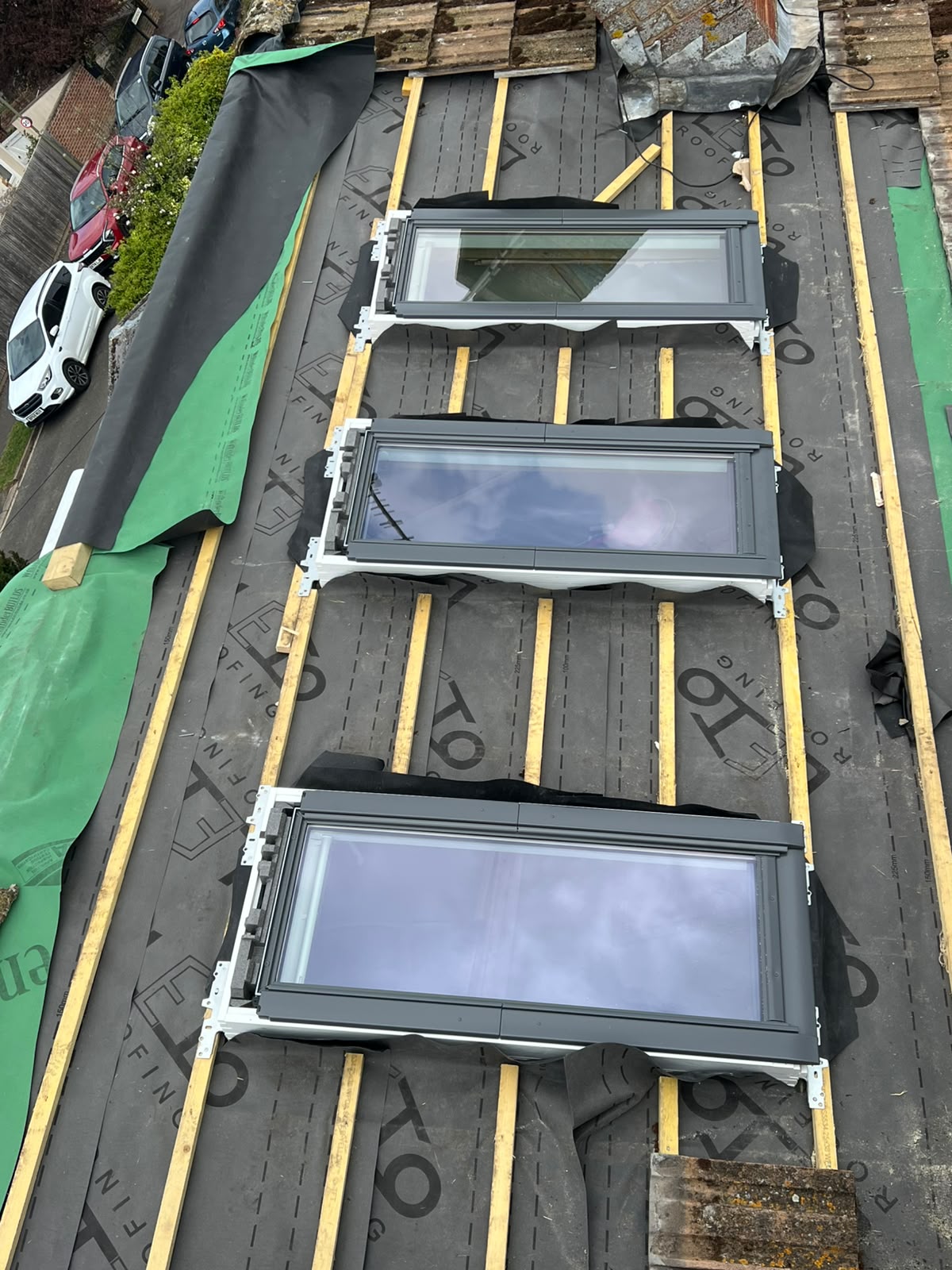
Position on the roof slope: The bottom edge of the skylight should be between 900mm and 1200mm above the finished floor level for comfortable viewing when seated, and the top edge should ideally be at 1800-2000mm for a standing eyeline. On a roof with a 40-degree pitch (common on inter-war housing across Slough and Reading), this typically means the window sits about one-third of the way up the rafter from the wall plate. We always consider the tile coursing — the window position needs to align with the tile layout to avoid awkward cuts and ensure clean weathering details.
Orientation matters: North-facing skylights provide consistent, glare-free daylight that is ideal for home offices and kitchens. South-facing skylights deliver maximum light but can overheat in summer — we always recommend specifying a blind or solar-control glass variant (Velux 70Q or 66Q coatings) for south-facing installations. East and west orientations provide good morning or afternoon light respectively, with moderate solar gain.
During our free survey, we assess all of these factors on site, take measurements, and use our experience to recommend the optimal window size, position and specification for your particular room and roof structure. We will also check for any obstructions in the roof — water tanks, vent pipes, electrical cables, purlins — that might affect the placement.
Planning Permission and Building Regulations for Skylights
One of the questions we are asked most frequently is whether planning permission is needed for a skylight. The answer, in most cases, is straightforward — but there are important exceptions that homeowners in Berkshire, Surrey and the Home Counties need to be aware of.
Planning permission: Under Permitted Development rights (Part 1, Class C of the General Permitted Development Order), you can install a roof window on any roof slope without planning permission provided it does not protrude more than 150mm beyond the plane of the roof slope. Since modern skylights like Velux and Fakro units sit within or flush with the roof plane, this condition is almost always met. However, Permitted Development does NOT apply if your property is a listed building, in a Conservation Area, in an Area of Outstanding Natural Beauty (AONB), or if previous extensions have used up your PD allowance. Several areas we serve — including parts of Windsor, Virginia Water and some villages in the Chilterns — fall within Conservation Areas or the AONB, so we always check before proceeding.
Building Regulations: Unlike planning permission, Building Regulations approval IS required for most skylight installations because you are creating a structural opening in the roof. The key regulations that apply are:
- Part A (Structure) — The roof timbers around the opening must be properly trimmed to maintain structural integrity. This means installing trimmer rafters and trimmers to redistribute the load, sized to the structural engineer or manufacturer specification.
- Part B (Fire Safety) — If the skylight is within 1 metre of a boundary, the glass may need to be fire-rated. Relevant for terraced houses and properties with side-facing roof slopes close to the plot boundary.
- Part F (Ventilation) — Habitable rooms must have adequate background and purge ventilation. Opening skylights contribute to both.
- Part L (Energy Efficiency) — The skylight must meet minimum thermal performance requirements. Current regulations require a whole-window U-value of 1.4 W/m2K or better. All current Velux, Fakro and Keylite units meet or exceed this standard.
- Part N (Glazing Safety) — Skylights installed below 800mm from finished floor level must use safety glass (toughened or laminated). Virtually all modern roof windows already comply.
We handle the Building Regulations process on your behalf, including submitting the application (or using a Competent Person scheme where eligible), arranging inspections, and ensuring all documentation is in order for sign-off. This paperwork matters — if you ever sell the property, the buyer solicitor will ask for Building Regulations completion certificates for any structural work.
Maintenance and Avoiding Common Skylight Problems
A well-installed skylight should give you decades of trouble-free service, but a small amount of annual maintenance goes a long way towards preventing the most common issues we see when called out to repair other installers work across Slough, Maidenhead and the wider Berkshire area.
Condensation: This is by far the most common complaint about skylights, and in the vast majority of cases it is a ventilation problem, not a window problem. Warm, moist air from cooking, bathing and breathing rises to the highest point of the room — which is exactly where your skylight sits. If the room does not have adequate background ventilation (trickle vents, extractor fans, or the window's own ventilation flap), moisture condenses on the coldest surface, which is the glass. Our installation always includes setting up the trickle vent and advising you on ventilation management. If you are experiencing condensation on an existing skylight, check that the trickle vent is open before assuming the window is faulty.
Flashing kit maintenance: The aluminium flashing kit that surrounds the window is designed to last the life of the window, but the foam seals and rubber gaskets within the kit can degrade over 15-20 years, particularly on south-facing slopes where UV exposure is highest. We recommend a visual check from inside the loft space annually — look for any daylight showing around the frame edges, or damp staining on the plasterboard around the window. If you spot either, call us for an inspection before a minor seal failure becomes a major leak.
Glass cleaning: Most modern skylights (Velux, Fakro, Keylite) have a centre-pivot mechanism that allows the sash to rotate 180 degrees, bringing the outer glass surface inside for cleaning. Clean the glass twice a year with warm soapy water — avoid abrasive cleaners or pressure washers, which can damage the external coatings. While the sash is rotated, take the opportunity to clear any debris from the drainage channels at the bottom of the frame. These channels are designed to drain away any water that gets past the outer gasket, and if they become blocked with leaves or moss, the water backs up and can overflow into the room.
Hinge and mechanism lubrication: Apply a small amount of silicone spray or light machine oil to the hinge mechanism once a year. This keeps the opening action smooth and prevents the stiffness that leads to excessive force being applied — which is how hinge bars get bent and broken. For electric or solar-powered units (Velux INTEGRA), ensure the control pad battery is replaced annually and test the rain sensor function by dripping water onto the external sensor.