The Complete Guide to Roof Cleaning and Maintenance
Why Moss and Algae Are More Than Just a Cosmetic Problem
Many homeowners look at a moss-covered roof and think it is merely unsightly. In reality, biological growth is one of the primary causes of premature roof failure, and understanding the mechanisms involved explains why regular cleaning is such an important part of roof maintenance.
Moisture retention: Moss acts like a sponge, absorbing and holding rainwater against the tile surface long after the rain has stopped. A thick layer of moss can hold several times its own weight in water. This persistent moisture has two damaging effects: it dramatically increases the rate of frost damage (water held in surface pores expands when it freezes, progressively spalling the tile face), and it keeps the underlying timber battens damp for longer, accelerating rot. Across the older housing stock in Slough, Reading and Maidenhead, we regularly find that moss accumulation is the primary cause of batten decay, particularly on north-facing roof slopes where the growth is heaviest and drying is slowest.
Root penetration: Moss does not simply sit on the tile surface — it anchors itself with root-like structures called rhizoids that penetrate into the surface material. On concrete tiles, which are porous, this penetration can be several millimetres deep. Over years of growth, these rhizoids create a network of micro-channels that increase the tile water absorption and reduce its structural integrity. On natural slate, the penetration is less but the rhizoids exploit natural cleavage planes in the stone, gradually prising layers apart. We have removed moss from concrete Marley Ludlow tiles and found the tile surface underneath completely friable — crumbling to the touch because years of moss growth have destroyed the cement matrix.
Water damming: Heavy moss growth at the bottom edge of tiles creates a dam that prevents water from draining cleanly off the tile course below. Instead, the water backs up and is forced under the overlap, soaking the underlay and eventually reaching the timber structure. This is a very common cause of leaks that homeowners find puzzling — the tiles appear intact, there are no cracked or slipped tiles, yet water is getting in. The culprit is moss at the tile margins redirecting water flow.
Gutter and valley blockage: As moss dries and breaks off, fragments wash into the gutters and valleys where they form compacted blockages. Blocked gutters overflow, saturating fascia boards and soffit panels and causing the decay that eventually requires replacement. Blocked valleys create pools that overflow under the tile edges, causing the same damp problems inside as a roof leak. During our roof cleaning work across Berkshire and Surrey, we always clear the gutters and valleys as part of the service because there is no point cleaning the roof if the drainage system is still choked with old moss debris.
Soft Wash vs Pressure Washing: What Actually Works
This is one of the most important distinctions in roof cleaning, and choosing the wrong method can cause more damage than the moss itself. Here is the honest truth about both approaches, based on our extensive experience cleaning roofs across every type of property in Berkshire, Surrey and Greater London.
Pressure washing uses high-pressure water (typically 100-200 bar) to blast moss and algae off the tile surface by sheer force. It is fast, visually dramatic, and produces immediately satisfying before-and-after results. However, it has significant drawbacks for roof cleaning. The high pressure strips off the surface layer of concrete tiles, removing the factory-applied acrylic coating that provides much of the tile weather resistance. Once this coating is gone, the exposed concrete absorbs water much more readily, making it more vulnerable to frost damage and accelerating regrowth. On interlocking concrete tiles like Marley Modern and Redland 49, the pressure can also damage the interlocking nibs and weathering bars, compromising the tile ability to keep water out. On natural slate, high pressure can delaminate the surface layers. And on older clay tiles, it can crack and break them outright. We strongly advise against pressure washing roofs.
Soft washing is the professional approach and the method we use exclusively at Dripstop Roofing. It combines low-pressure water (typically 10-30 bar — similar to a garden hose with a nozzle) with a professional-grade biocidal cleaning solution that kills the moss, algae and lichen at a cellular level. The process works in two stages. First, we manually scrape and brush the heaviest moss deposits from the tile surface, ridges and valleys. This removes the bulk material and opens up the underlying growth to the biocide. Second, we apply the biocide solution across the entire roof surface at low pressure, ensuring even coverage and thorough penetration into every crevice, overlap and gap.
The biocide we use (Benz Bio Cleanze or Algon Organic Path and Patio Cleaner for lower-level work) is a professional-grade quaternary ammonium compound that is highly effective against moss, algae and lichen. It is biodegradable, safe for use near plants when diluted correctly, and does not damage tile surfaces, lead flashings or plastic guttering. The solution continues working for several weeks after application, gradually bleaching out residual staining and killing any remaining spores. Full results are typically visible within four to eight weeks.
The key advantage of soft washing is that it kills the growth at the root (literally) rather than just knocking it off the surface. Pressure washing removes what you can see but leaves the root structures embedded in the tile, which means regrowth starts almost immediately. Soft washing kills everything, including the roots and spores, giving you three to five years of protection before any significant regrowth occurs.
Annual Maintenance Checklist for Homeowners
Even between professional cleaning and inspection visits, there are simple checks that any homeowner can carry out from ground level to spot potential problems early. We recommend the following annual routine, ideally carried out in late autumn (after the leaves have fallen) and again in early spring.
- Visual tile check: Stand back from the house and look at each roof slope in turn. You are looking for tiles that appear to have slipped (they will be lower than their neighbours or sitting at an odd angle), cracked or broken tiles (visible gaps or pieces missing), and areas where the tile colour or texture differs markedly from the surrounding area (which may indicate replacement tiles that are not weathering to match, or areas of heavy moss or algae growth).
- Ridge line inspection: Look along the ridge line from both ends. The ridges should be straight and even with consistent mortar joints. If you can see gaps in the mortar, ridges that appear to be lifting, or rocking movement in windy conditions, the ridge pointing is failing and needs re-bedding. This is one of the most common maintenance items on roofs across Berkshire and is a straightforward repair when caught early.
- Gutter check: Walk around the property during or immediately after rain and look at each gutter run. Water should be flowing smoothly into the downpipes without overflowing. Any overflow point indicates a blockage. Also look for gutters that are sagging or pulling away from the fascia — this indicates failed brackets or rotting fascia boards.
- Flashing check: Look at the flashings around chimney stacks, where the roof meets walls, and in the valleys. You are looking for lead that has lifted away from the wall, gaps between the flashing and the brickwork, or any visible sealant or cement that has cracked or fallen out. Flashing failures are one of the most common causes of roof leaks and are usually inexpensive to repair if caught early.
- Internal loft check: If you have access to your loft, go up with a torch twice a year and look for any signs of daylight coming through (which indicates a slipped or missing tile), damp patches on the underlay or timbers, and any increase in condensation. Pay particular attention to the areas around chimneys, valleys and any previous repair work.
If you spot any of these issues during your own checks, call us on 07405 391861 for a professional assessment. Most problems found early are quick and inexpensive to fix — it is only when they are left for months or years that they develop into major repairs.
When Cleaning Is Not Enough and Replacement Is Needed
There comes a point in every roof life when cleaning and maintenance can no longer restore it to a functional condition, and replacement becomes the more cost-effective option. Recognising this threshold is important because continuing to spend money on cleaning a roof that has reached the end of its serviceable life is a waste of money. Here are the signs we look for when assessing whether a roof can be cleaned and maintained or needs replacing.
Severe surface erosion: If concrete tiles have lost their surface coating over a large area and the aggregate is visible and exposed, the tiles have lost much of their weather resistance. Cleaning will remove the moss but will not restore the surface integrity. Similarly, if natural slates have delaminated significantly (layers peeling apart), they have exceeded their service life. In both cases, the tiles will continue to absorb excessive water, frost damage will accelerate, and no amount of biocide treatment will reverse the physical deterioration.
Widespread nail fatigue: Tiles are fixed to the battens with nails, and these nails corrode over time. When nail fatigue becomes widespread — meaning tiles across the roof are loose and prone to slipping or lifting in wind — re-nailing individual tiles becomes impractical. This is a common issue on roofs from the 1960s and 1970s across Slough, Reading and the wider Thames Valley, where galvanised nails were used that have now corroded after 50-60 years. A roof with widespread nail fatigue is a re-roofing job, not a cleaning job.
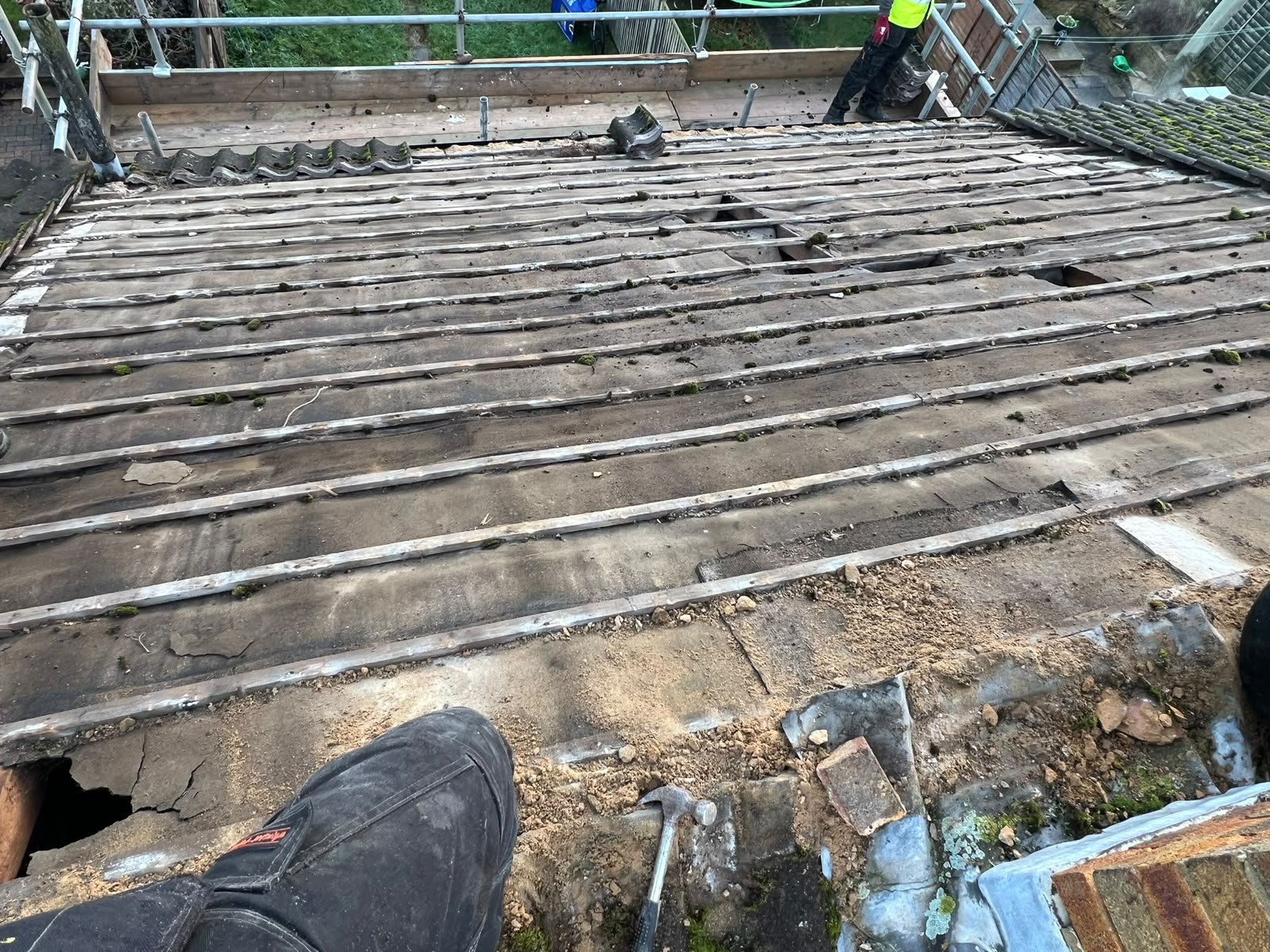
Batten decay: If the timber battens (the horizontal timbers to which the tiles are nailed) have rotted, the tiles have nothing to fix to. We can assess batten condition by lifting individual tiles during a survey. If the battens are soft, dark and crumbly, the roof needs stripping and re-battening. This is effectively a full re-roof because every tile has to come off to replace the battens underneath. Batten decay is almost always caused by persistent moisture from either moss accumulation, failed underlay, or inadequate ventilation — which is exactly why regular maintenance and cleaning prevent this expensive outcome.
We are always honest in our assessment. If your roof can be cleaned and maintained for another ten or fifteen years, we will tell you and provide a fair price for the work. If it needs replacing, we will tell you that too, and explain exactly why. We would rather earn your trust with an honest assessment than take your money for a cleaning that will not solve the underlying problem. Call 07405 391861 for a free roof assessment across Berkshire, Surrey and Buckinghamshire.