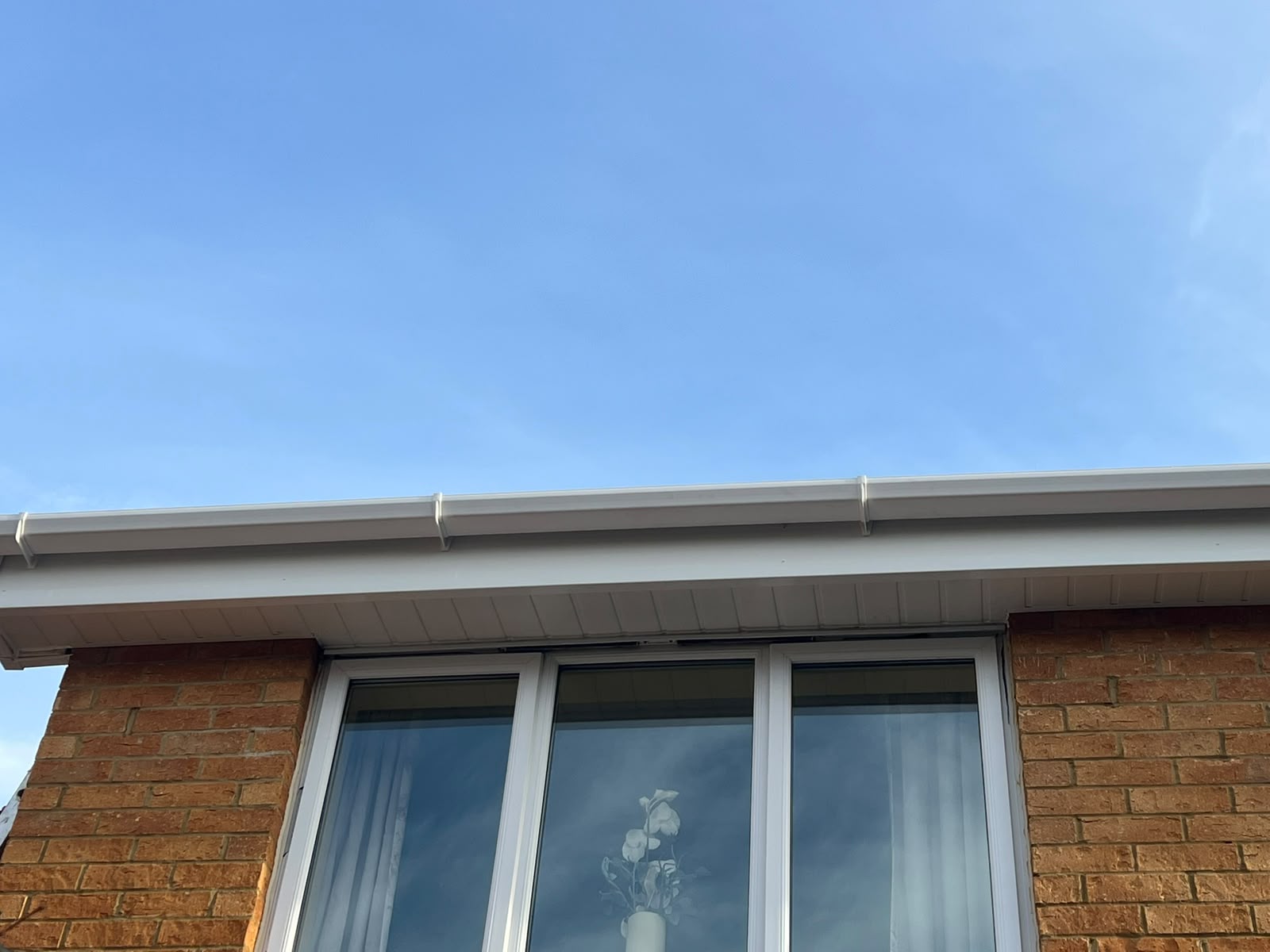
The complete guide to gutter installation
Types of guttering systems explained
Choosing the right gutter profile is not just about aesthetics — it directly affects how much rainwater your system can carry. The most common profiles fitted across Berkshire and the Home Counties are half-round, ogee (also called OG or moulded), square-line and deep-flow. Each has distinct characteristics that make it more or less suitable for different property types.
Half-round guttering is the classic choice for most UK homes. Its semicircular channel is simple, effective and available in every material from budget uPVC to premium cast iron. A standard 112mm half-round uPVC gutter handles roughly 50% more flow than many homeowners realise, making it perfectly adequate for the majority of semi-detached and terraced houses with modest roof areas. The smooth internal curve also means debris tends to wash through rather than snag, reducing blockage risk.
Ogee guttering features a decorative moulded front face that gives properties a more refined look. It is particularly popular on detached houses, bungalows with visible rooflines and period-style new builds. The ogee profile typically holds a similar volume to half-round but its flat back sits flush against the fascia board, creating a cleaner line. Manufacturers like Polypipe and FloPlast offer ogee in white, black, brown, anthracite grey and caramel finishes, making colour-matching straightforward.
Square-line systems — sometimes marketed as high-capacity square guttering — feature a boxy rectangular profile. They are commonly specified on commercial buildings, large detached properties and extensions with wide roof spans. Their angular shape lends a contemporary feel and their higher internal volume can handle significantly greater flow rates than half-round equivalents of the same external width.
Deep-flow guttering is essentially a scaled-up half-round or ogee profile, typically 150mm or 170mm wide rather than the standard 112mm. When a standard system cannot cope — perhaps the roof pitch is steep, the elevation faces prevailing weather, or multiple roof planes converge into a single run — deep-flow provides the extra capacity without needing to double up on downpipes. We often recommend deep-flow for properties in exposed positions around the Chilterns and along the Thames Valley where heavy driven rain is common.
- Half-round 112mm — suits most terraced and semi-detached homes with roof areas up to roughly 55 m²
- Ogee 110mm — decorative option, similar capacity, popular on detached houses and bungalows
- Square-line 114mm — contemporary look, higher volume, ideal for flat-roof extensions and modern builds
- Deep-flow 150–170mm — handles large roof areas, steep pitches and exposed elevations
Material comparison: uPVC, aluminium and cast iron
The material you choose affects cost, appearance, lifespan and maintenance requirements. Each has genuine advantages and trade-offs that are worth understanding before committing to a quote.
uPVC is by far the most popular guttering material in the UK and for good reason. It is lightweight, corrosion-proof, comes in a wide range of colours and profiles, and costs a fraction of metal alternatives. A well-installed uPVC system from a quality manufacturer like Polypipe or Brett Martin will comfortably last 15–25 years before UV degradation and thermal cycling begin to take their toll. It is the workhorse of the industry and what we fit on the majority of residential projects. The main downsides are its thermal expansion — uPVC expands by roughly 3mm per 2m length over a 20°C temperature swing, which is why expansion joints and correct bracket spacing are critical — and its relatively limited lifespan compared to metals.
Aluminium guttering sits in the sweet spot between plastic and premium metals. Powder-coated aluminium systems like Marley Alutec Aligator and Lindab Rainline offer a 30–50 year lifespan, resist UV degradation entirely, can be colour-matched to almost any RAL shade, and weigh only marginally more than uPVC. Aluminium does not expand and contract to the same degree as plastic, so joints remain tighter over time. We increasingly recommend aluminium for homeowners who want a long-term solution without the maintenance demands of cast iron. Prices typically run two to three times higher than uPVC, but when you factor in the extended lifespan and near-zero maintenance, the total cost of ownership is often lower.
Cast iron guttering remains the gold standard for heritage properties, listed buildings and conservation areas across Berkshire and the surrounding counties. Products from manufacturers like Tuscan Foundry, J&R Foundry and Hargreaves replicate every original Victorian and Edwardian profile, from half-round to moulded ogee to deep Victorian. Cast iron is phenomenally durable — many original runs are still functioning after 100+ years — but it does require periodic painting to prevent rust. Installation is also more labour-intensive because of the weight, and scaffolding is almost always necessary. For listed buildings, the local conservation officer will typically require like-for-like replacement in cast iron, and we work closely with councils across Slough, Windsor & Maidenhead, and South Bucks to ensure compliance.
- uPVC — lowest cost, 15–25 year life, no painting, wide colour range, expansion joints required
- Aluminium — mid-range cost, 30–50 year life, powder-coated in any RAL colour, minimal expansion
- Cast iron — premium cost, 80–100+ year life, requires painting every 5–8 years, heritage compliance
- Zinc and copper — specialist materials, self-patinating, 60+ year life, typically specified by architects
Sizing gutters correctly to BS EN 12056
British Standard BS EN 12056-3 governs the design and calculation of rainwater drainage systems. It might sound dry, but getting this right is the difference between a guttering system that copes effortlessly and one that overflows at the first heavy downpour. The standard requires installers to calculate the effective roof area, factor in the rainfall intensity for the geographic location, and then select a gutter and downpipe combination that can handle the design flow rate.
Effective roof area is not simply the plan area of the roof — it also accounts for wind-driven rain on vertical surfaces and the pitch of the roof. A steep-pitched roof (say 45 degrees) collects significantly more wind-driven rain than a shallow 15-degree pitch, so the effective area is larger. In the Thames Valley, the design rainfall intensity used is typically 75mm per hour, which is the figure specified for most of Southern England in BS EN 12056. For exposed sites or properties with a history of overflow, we sometimes use a higher intensity figure as a safety margin.
Once we have the effective area and design intensity, we calculate the design flow rate in litres per second and cross-reference it against manufacturer flow-rate data for the chosen profile and downpipe size. For example, a 112mm half-round gutter with a single 68mm round downpipe at one end can typically handle around 0.9 litres per second — adequate for a straight terrace elevation of modest length. Move the outlet to a central position and the capacity roughly doubles because the water flows in two directions. Add a second outlet and you can handle much larger areas.
We carry out these calculations on every job, even straightforward domestic replacements. It takes minutes and ensures the system is right first time. Many of the overflow problems we are called out to fix stem from gutters that were installed without any sizing calculation — often the previous installer simply matched what was there before, even when the original was undersized or the property had been extended.
- Always calculate effective roof area including pitch and wind exposure factors
- Use the local design rainfall intensity — 75mm/hr is standard for the Thames Valley
- Match gutter profile and downpipe size to the calculated design flow rate
- Position outlets centrally where possible to maximise gutter capacity
- Consider deep-flow profiles or additional outlets where roof areas are large or converging
Building regulations and planning considerations
Standard gutter replacement on a residential property in England does not normally require Building Regulations approval or planning permission, as it falls under permitted development. However, there are important exceptions. If your property is in a conservation area, replacing gutters with a different material or profile may require planning consent — for example, switching from cast iron to uPVC on a period property in the Old Windsor Conservation Area could trigger an enforcement notice.
Listed buildings have even stricter requirements. Any alteration to a listed building, including changing guttering, requires Listed Building Consent from the local planning authority. We have experience navigating these requirements across Slough Borough Council, the Royal Borough of Windsor & Maidenhead, and South Bucks District Council, and can advise on what is likely to be acceptable before you commit to a material choice.
On the Building Regulations front, Approved Document H covers drainage and waste disposal. While it primarily concerns below-ground drainage, the interface between your guttering system and the underground drainage network is covered. If we are connecting new downpipes to existing drains, we ensure compliance with Part H, including adequate access points and correct pipe sizing. For new builds, the guttering specification will be included in the overall Building Regulations application and signed off by the approved inspector.
- Standard like-for-like gutter replacement — no planning permission or Building Regs needed
- Conservation area properties — check with the local planning authority before changing materials
- Listed buildings — Listed Building Consent required for any alteration to guttering
- New-build or major extension — guttering spec included in Building Regs submission
- Downpipe-to-drain connections must comply with Approved Document H