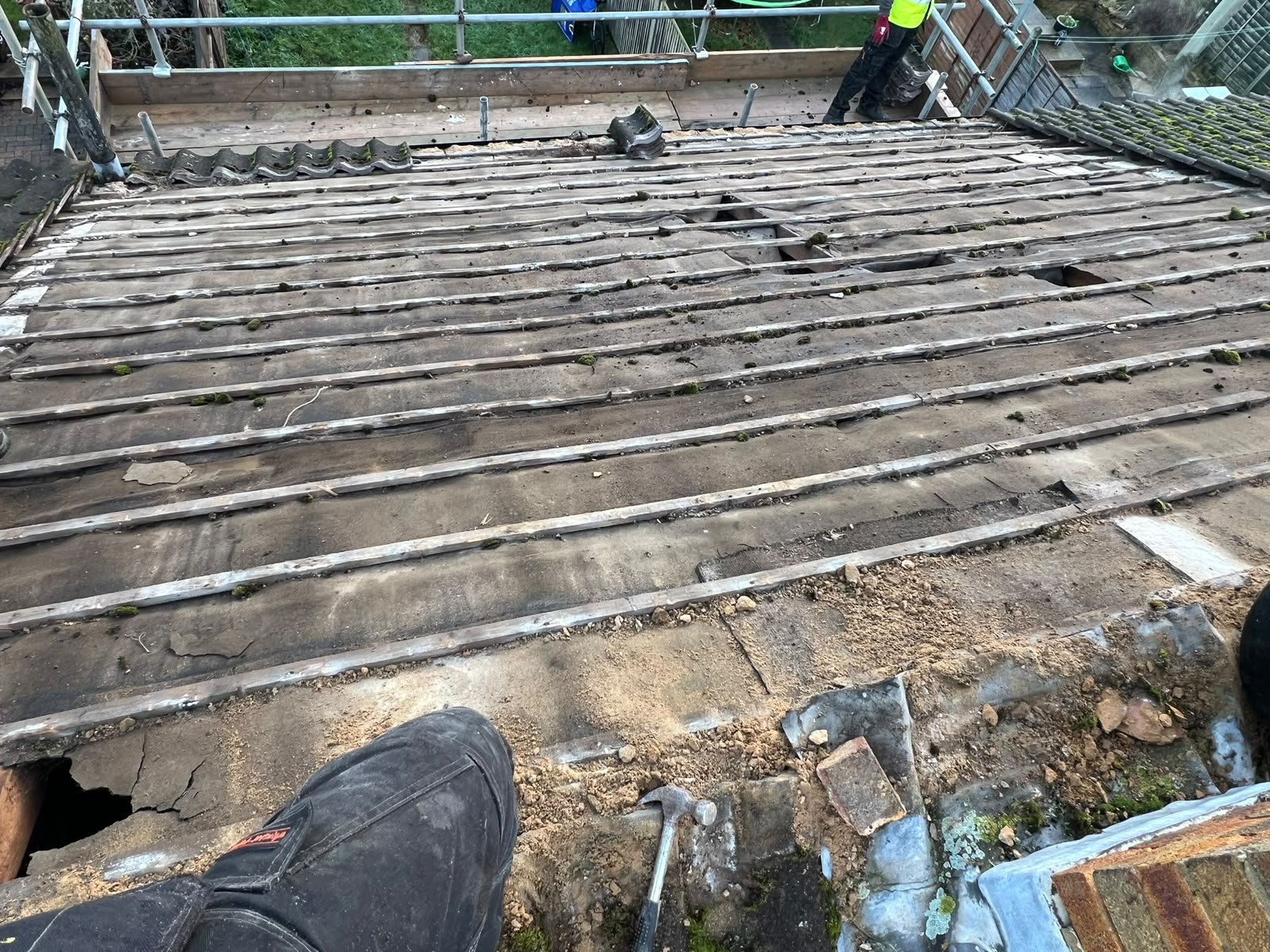
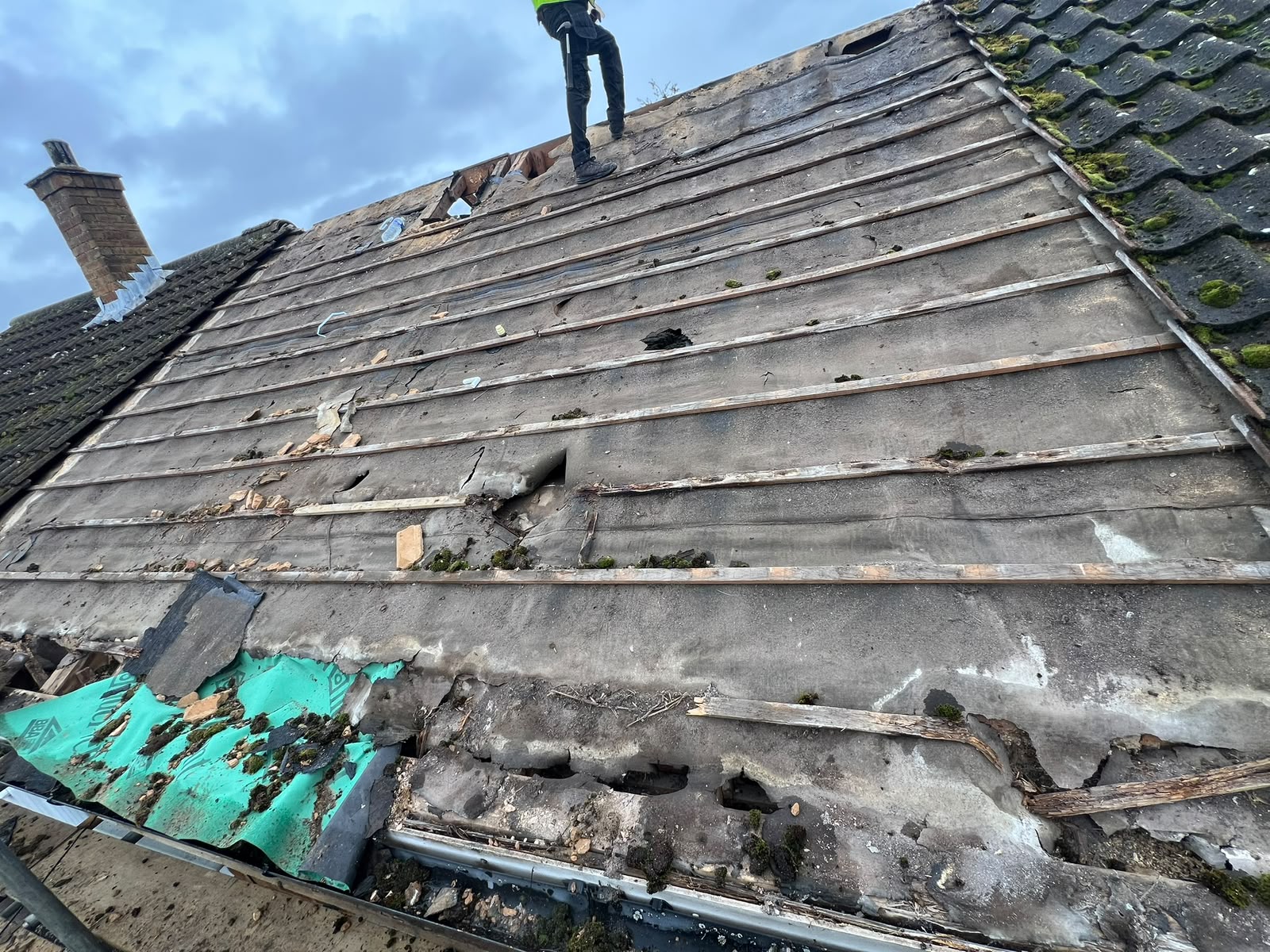
Emergency Roofing — What Every Homeowner Needs to Know
What to Do in the First Hour of a Roof Emergency
Discovering that your roof has been damaged — whether from a storm, a fallen branch, or a sudden catastrophic leak — is stressful. Here is a step-by-step guide to what you should do in the first hour to protect your home, your family, and your insurance position.
First and most importantly: stay safe. Do not climb onto your roof under any circumstances, especially during a storm or high winds. Do not go into your loft space if you suspect structural damage — sagging ceilings, cracked beams, or active water ingress around electrical fittings all indicate potential danger. If water is coming into contact with light fittings or electrical sockets, switch off the power to the affected circuits at your consumer unit and call an electrician as well as a roofer.
Second, contain the water. Place buckets, washing-up bowls, or any large containers under active leaks. If water is pooling on a ceiling and causing it to bulge, carefully puncture the bulge at its lowest point with a screwdriver to release the water in a controlled way into a container below — this prevents the entire ceiling from collapsing under the weight of the water.
Third, call Dripstop Roofing on 07405 391861. Give us your address, describe what has happened, tell us if water is actively entering the property, and let us know about any safety concerns (fallen trees, structural movement, electrical involvement). We will prioritise your call and get a team to you as quickly as conditions allow.
How to Protect Your Home While Waiting for the Roofer
While you wait for our emergency team to arrive, there are several practical steps you can take to minimise damage — all from the safety of inside your property.
If the power is still on and there is no risk of water contacting electrical fittings, try to keep the heating running at a low level. Warmth helps damp areas dry more quickly once the leak is contained. However, if you have any doubt about the safety of your electrics — water near light fittings, sparking, tripped circuits — switch off at the consumer unit and call an electrician. Water and electricity are a potentially fatal combination.
It is also worth noting that your actions in these first hours directly affect your insurance claim. Insurers expect policyholders to take 'reasonable steps to mitigate further loss' — this is a standard condition written into virtually every home insurance policy in the UK. By containing the water, protecting your belongings, and calling a professional roofer promptly, you are fulfilling this obligation. Conversely, if you do nothing and allow damage to escalate, your insurer may reduce the payout on the grounds that you failed to mitigate. Keep a record of everything you do — times, actions taken, photographs — as this strengthens your claim.
- Move furniture, electronics, and valuables away from the affected area. Even if the leak seems small, it can spread rapidly — clear the area generously.
- Remove items from loft storage if it is safe to access the loft. Boxes of belongings stored in the loft can be destroyed by water ingress and also prevent our team from accessing the damage.
- Photograph everything — the damage to the roof (from ground level), the water ingress points, the damage to ceilings, walls, and belongings. Timestamped photos are the single most valuable piece of evidence for an insurance claim.
- Do not attempt to patch the roof from outside. Climbing onto a wet, damaged roof in storm conditions is extremely dangerous. Our team has the equipment, training, and experience to do this safely.
- Contact your home insurance company to open a claim. Most insurers have 24-hour claims lines. Give them a brief description and tell them your roofer is attending — they will assign a claim number and in some cases authorise emergency works up to a set limit.
Insurance Claims — A Step-by-Step Guide for Homeowners
Navigating a home insurance claim after roof damage can be confusing, especially when you are dealing with the immediate stress of a leak or storm damage. Here is how the process typically works, and how Dripstop Roofing supports you through it.
Step one: Contact your insurer as soon as possible after the damage occurs. Most policies require you to report damage 'promptly' — ideally within 24-48 hours. You will be given a claim reference number. Step two: Take reasonable steps to prevent further damage (this is actually a condition of most policies — you are expected to mitigate the loss). Our emergency weatherproofing service fulfils this requirement. Step three: Do not throw away damaged materials or dispose of evidence until the insurer or loss adjuster has had a chance to inspect.
Dripstop Roofing provides a full documentation package for insurance claims: a detailed written report describing the damage, its cause, and the repairs required; timestamped photographs of the damage, the emergency weatherproofing, and the permanent repairs; and an itemised quotation with clear breakdowns of labour, materials, scaffolding, and waste disposal. We also liaise directly with loss adjusters when requested — our clear, professional reports typically speed up the claims process significantly.
One important note: most standard home insurance policies cover sudden, storm-related damage but do not cover damage caused by lack of maintenance. If your insurer determines that the damage was caused by pre-existing wear and tear (for example, ridge tiles that were already loose before the storm), they may reduce or deny the claim. This is another reason why regular maintenance and periodic professional inspections are so important.
When Temporary Fixes Become Permanent Problems
Emergency weatherproofing — tarpaulins, temporary felt patches, quick-set flashing tape — is designed to keep the water out until permanent repairs can be completed. It is not designed to be a permanent solution. Unfortunately, we see far too many properties across Berkshire and the Home Counties where a 'temporary' fix has been left in place for months or even years, causing significantly more damage than the original problem.
Tarpaulins degrade under UV exposure within 3-6 months. They can also trap moisture underneath, accelerating the decay of timbers that might otherwise have dried out. Temporary flashing tapes lose adhesion within weeks in British weather conditions. Quick-patch repairs to felt flat roofs will almost always fail within one winter cycle.
Our advice is straightforward: treat emergency repairs as buying time — typically 2-4 weeks — not as a permanent solution. We always schedule permanent repair work as quickly as possible after an emergency call-out, and we work with you and your insurer to ensure the timeline is practical. If cost is a concern, we offer flexible payment options and can phase repairs if needed — but leaving temporary fixes indefinitely always costs more in the long run.
We have attended properties in Slough and Reading where temporary tarpaulins had been in place for over a year. In every case, the underlying damage was dramatically worse than it would have been if permanent repairs had been carried out within the recommended timeframe. Trapped moisture had caused extensive wet rot in rafters and purlins, the ceiling plasterboard had swollen and collapsed, and in one case, the insulation was so waterlogged it had to be completely stripped and replaced — adding thousands of pounds to the final repair bill. The tarpaulin itself had degraded to the point where it was no longer providing effective weatherproofing, effectively leaving the property exposed for months without the homeowner realising. This is why we follow up on every emergency call to ensure permanent repairs are scheduled and completed within a reasonable timeframe.