The Complete Guide to Chimney Repairs in Berkshire
Common Chimney Problems and How to Spot Them
Chimney stacks endure more punishment than any other part of your roof. Perched at the highest point of the building and fully exposed on all sides, they face driving rain, frost cycles, high winds, and intense UV radiation year after year. Over time, this relentless weathering causes a range of problems that, if left unaddressed, can compromise the structural integrity of the stack and allow water into your home.
The most common chimney fault we encounter across Slough, Reading, Windsor, and the surrounding Berkshire towns is failed mortar joints. Mortar has a finite lifespan — typically 25 to 50 years depending on the mix used and the exposure of the chimney. Once the mortar begins to recede and crumble, water penetrates the joints, accelerating decay through freeze-thaw cycles in winter. You will often notice the first signs as fine sand or mortar debris collecting in the gutter below the chimney.
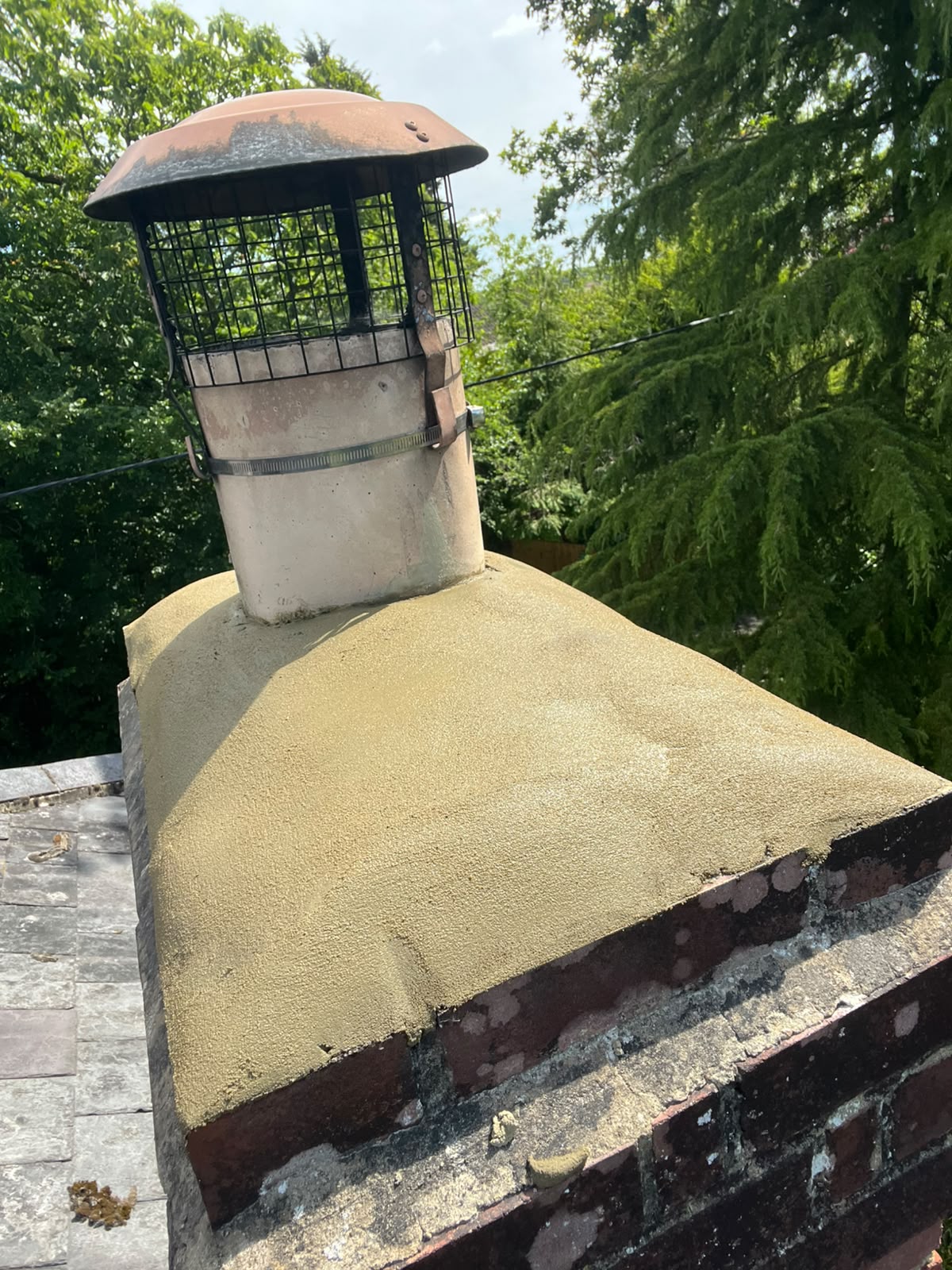
Cracked or missing flaunching is another extremely common issue. Flaunching is the cement mortar shaped around the base of chimney pots to hold them in place and shed rainwater away from the stack. When it cracks, water runs straight down into the chimney, causing internal damp, staining on the chimney breast, and eventually damaging the flue liner. We see many cases across Greater London and Surrey where homeowners have lived with chimney breast damp for years without realising the flaunching was the culprit.
More serious problems include leaning chimney stacks, spalling brickwork, and sulphate attack. Leaning stacks are particularly common in the Thames Valley, where prevailing south-westerly winds exert sustained lateral pressure on tall chimney stacks over decades. Spalling — where the face of the brick flakes off — is often caused by moisture trapped inside the brick expanding during frost. Sulphate attack occurs when sulphates from old flue deposits react with moisture and cement mortar, causing the mortar to expand and crack the brickwork from within.
- Mortar joints receding or crumbling between bricks
- Cracks visible in the flaunching around chimney pots
- Damp patches or staining on the chimney breast inside the house
- Chimney pots loose, tilting, or missing entirely
- Visible lean or bulge in the chimney stack viewed from the ground
- Brick faces flaking or spalling, particularly on the windward side
- White salt deposits (efflorescence) on the brickwork surface
Flaunching vs Capping: Which Does Your Chimney Need?
One of the most frequent questions we are asked during chimney inspections in Buckinghamshire and Berkshire is whether the chimney needs new flaunching or a cap. The answer depends on whether the chimney is still in active use or has been decommissioned.
Flaunching is the traditional method of weatherproofing the top of a chimney stack. A properly shaped bed of sand-and-cement mortar is applied around each pot, creating a sloped surface that directs rainwater outward and over the edges of the stack. Good flaunching should have a smooth finish with no cracks, a pronounced slope, and a slight overhang or drip edge to prevent water from running down the brickwork face. When we renew flaunching, we always use a strong but flexible mix and ensure adequate thickness — typically 50 to 75 millimetres at the pot base, tapering to 25 millimetres at the edge.
A chimney cap, by contrast, is a prefabricated cover — usually concrete, terracotta, or metal — that sits over the entire top of the chimney stack. Caps are most appropriate for chimneys that are no longer in use, as they provide a complete seal against rain while still allowing some ventilation through small vents. They are increasingly popular in Slough and the surrounding area because they offer a long-term, low-maintenance solution for redundant chimneys. However, if you have a working open fire, stove, or gas appliance venting through the chimney, a cap is not suitable — you need functional flaunching and an appropriate cowl or terminal instead.
We often recommend a combination approach for properties with multiple chimney pots where some flues are active and others are disused. The active flues receive new flaunching and a ventilating cowl, while the disused flues are capped to prevent rain and bird ingress. This gives you the best of both worlds and reduces long-term maintenance requirements.
Structural Chimney Repairs vs Cosmetic Fixes
Not all chimney repairs are equal. There is an important distinction between cosmetic maintenance — such as repointing and flaunching renewal — and structural repairs that address the fundamental stability of the chimney stack. Understanding this distinction helps homeowners across Surrey, Berkshire, and Greater London make informed decisions about the work their chimney actually needs.
Cosmetic or maintenance repairs address surface-level deterioration. Repointing replaces failed mortar in the joints between bricks. Flaunching renewal replaces the mortar bed around the pots. Lead flashing repairs reseal the junction between chimney and roof. These repairs are typically straightforward, can often be completed in a day or two, and are essential for keeping water out and preserving the stack in good condition. We recommend chimney maintenance every 15 to 25 years, depending on the exposure and the quality of the original work.
Structural repairs are more involved. If a chimney stack is leaning more than 15 to 20 millimetres off plumb, it may need restraint straps bolted through the roof structure to arrest the lean, or in more severe cases, a complete dismantle and rebuild. Sulphate attack often requires a full rebuild because the mortar expansion has pushed the bricks apart internally, meaning the entire stack is compromised even if it looks passable from outside. Cracked chimney breasts inside the loft can also indicate structural movement that needs investigation.
At Dripstop Roofing, we always provide an honest assessment. If your chimney only needs repointing, we will tell you — we will never recommend unnecessary work. Equally, if the stack has a fundamental structural problem, we will explain exactly what is happening and give you clear options for repair or removal. Our goal is to protect your property and your budget in equal measure.
- Cosmetic repairs: repointing, flaunching, flashing, cowl fitting
- Structural repairs: rebuilding, restraint strapping, DPC insertion, foundation work
- Always get a professional assessment before committing to major chimney work
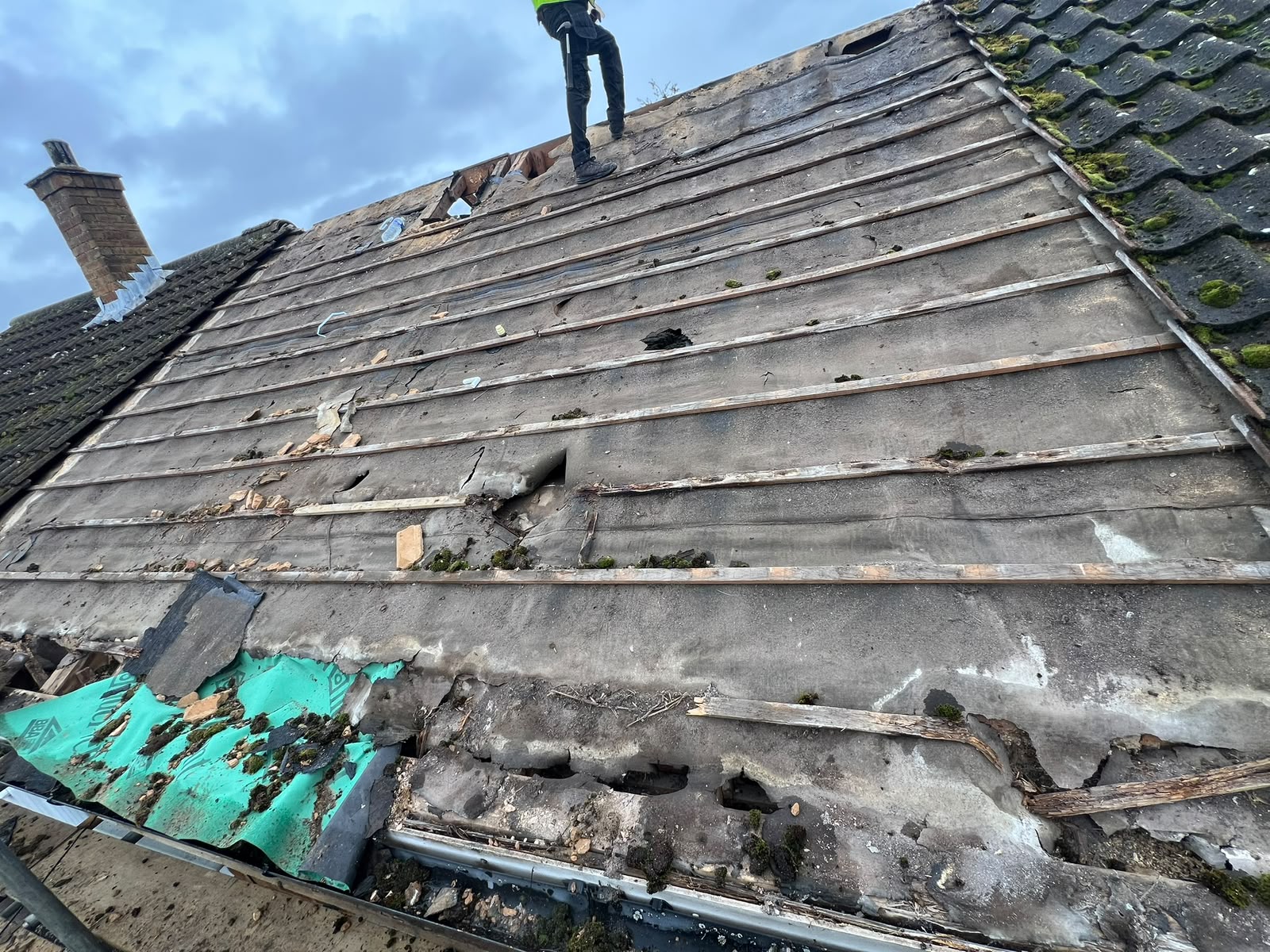
- Photographs from scaffold level give the clearest picture of chimney condition
When to Repair a Chimney vs When to Remove It
Sometimes a chimney has deteriorated to the point where homeowners in Berkshire and the surrounding counties face a genuine choice: repair or remove. Both options have their merits, and the right answer depends on your circumstances, your budget, and your plans for the property.
Repair is almost always the preferred option if the chimney is still serving an active flue — whether that is an open fire, a wood-burning stove, or a gas fire. Even a badly deteriorated chimney can usually be rebuilt above the roofline for between 1,500 and 3,500 pounds, which is significantly less than full removal when you factor in the cost of making good the roof, loft, and internal rooms afterwards.
Removal makes more sense when the chimney is completely redundant, the property has no fireplaces or they have been permanently sealed, and the chimney stack is in very poor condition. Removing a chimney stack eliminates the maintenance burden entirely, prevents future water ingress from that source, and can reduce wind loading on the roof structure. Partial removal — taking the stack down to just below the roofline and capping the remaining brickwork — is the most common approach and avoids the need to disturb the chimney breast internally.
If you are considering full chimney removal including the breast inside the house, be aware that this is a significant structural alteration. The chimney breast often supports the floor joists and ceiling above, so a steel beam or gallows bracket must be installed to carry the load. This work requires Building Regulations approval and, if you share a chimney with a neighbour, a Party Wall Agreement. We can manage the entire process for you, from initial survey through to Building Control sign-off.