The complete guide to aluminium guttering
Why aluminium is the smart choice for UK homes
The UK guttering market has been dominated by uPVC for the past 30 years, and it is easy to see why — it is cheap, lightweight, easy to install and available in every builders' merchant. But uPVC has a fundamental limitation: it degrades. Ultraviolet light from the sun breaks down the polymer chains, causing the material to become brittle, discolour and eventually crack. Thermal cycling — the constant expansion and contraction through British summers and winters — stresses joints and causes gaskets to fail. Most uPVC guttering has a realistic service life of 15 to 20 years in exposed positions, and considerably less on south-facing elevations that take the brunt of UV exposure.
Aluminium suffers from none of these problems. The base metal is inherently corrosion-resistant thanks to a natural oxide layer that forms on the surface, and the factory-applied polyester powder coating provides a tough, colour-stable finish that has been tested to withstand decades of weathering without fading, chalking or peeling. Manufacturers like Marley Alutec and Lindab back their products with 25 to 30 year guarantees on both the aluminium substrate and the powder-coat finish — and real-world performance consistently exceeds these figures.
The cost of aluminium guttering is typically two to three times that of uPVC, which understandably gives some homeowners pause. But consider the lifecycle: if a uPVC system lasts 18 years and an aluminium system lasts 40, you will need to replace the uPVC system at least once during the aluminium system's lifetime — and that second installation costs more than the original difference. Factor in the hassle, the scaffold hire, the disruption and the risk of water damage during the changeover, and aluminium starts to look like the more economical choice over a 30 or 40 year horizon.
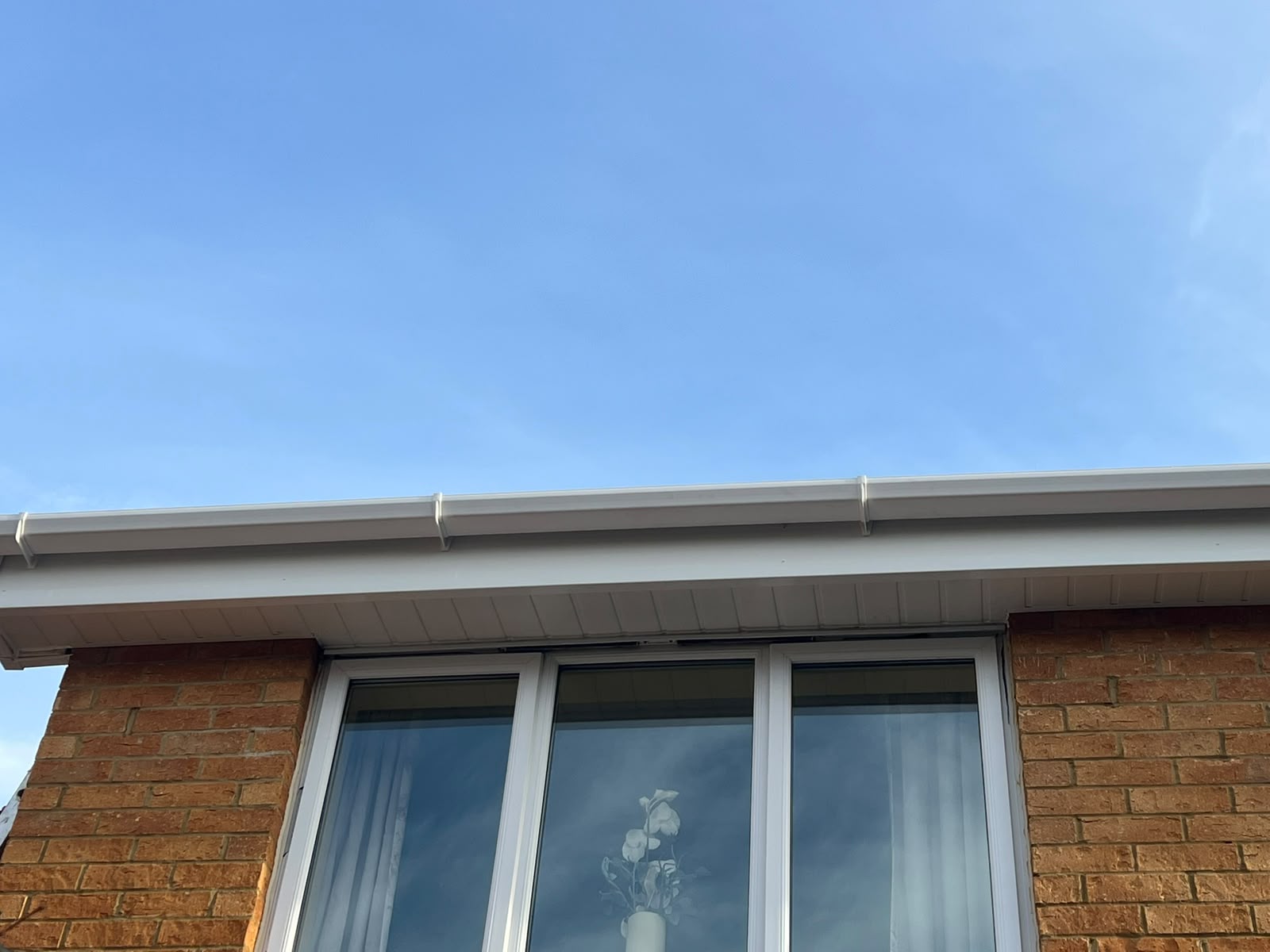
There is also the aesthetic argument. Aluminium guttering looks sharper, cleaner and more refined than uPVC. The profiles are crisper because the material can be formed to tighter tolerances, the colour is deeper and more uniform, and the system does not develop that slightly grubby, tired look that uPVC inevitably acquires after a few years of exposure. For homeowners who take pride in their property's appearance, that matters.
Powder coating and colour options
Every aluminium gutter system we install is factory powder-coated to a minimum thickness of 60 microns, applied electrostatically and oven-cured at approximately 200°C. This process creates an exceptionally hard, durable finish that bonds mechanically to the aluminium surface. Unlike liquid paint, powder coating does not run, drip or leave brush marks, and it provides consistent coverage including inside corners and recesses.
Standard stock colours include black RAL 9005, white RAL 9010, anthracite grey RAL 7016, dark grey RAL 7015 and brown RAL 8017. These are readily available and typically ship within a few working days. For bespoke colours — any of the 200+ RAL Classic shades — manufacturers offer a special order service with typical lead times of two to four weeks. We have installed aluminium guttering in heritage green, signal red, dusty pink and numerous other custom shades for clients who wanted a specific colour match.
One particularly popular option is the cast iron effect finish. Manufacturers like Marley Alutec offer a textured black powder coat that closely replicates the slightly rough, traditional appearance of cast iron, without the weight, maintenance or cost. This is an excellent choice for period properties in conservation areas where the local planning authority requires a traditional appearance but does not insist on actual cast iron. We have used it successfully on several properties in the Windsor and Eton conservation areas.
The powder coating is remarkably resilient. Independent weathering tests show no significant colour change after 25 years of simulated UK weather exposure, including UV, rain, frost and pollutants. Unlike uPVC, which begins to yellow or fade after 5 to 10 years in exposed positions, powder-coated aluminium retains its original colour throughout its service life. If the surface does get scuffed — from a ladder, for example — touch-up paint is available in matching colours for simple repairs.
- Standard colours: black, white, anthracite grey, dark grey, brown — available ex-stock
- Bespoke: any RAL Classic colour to order, 2–4 week lead time
- Cast iron effect: textured black finish replicating traditional iron appearance
- Minimum 60-micron powder coat thickness, electrostatically applied and oven-cured
- Proven colour stability — no significant fading after 25 years of weathering tests
Seamless versus sectional aluminium guttering
Aluminium guttering is available in two forms: sectional (pre-cut lengths joined on site) and seamless (formed on site from a continuous coil using a roll-forming machine). Each approach has advantages, and the right choice depends on your property, budget and priorities.
Sectional aluminium guttering works in a similar way to uPVC — pre-manufactured lengths (typically 3m or 4m) are joined using connectors sealed with a butyl or silicone-based compound. The joints are the potential weak points, just as they are with any sectional system, but aluminium's low thermal expansion means they stay tighter over time than uPVC equivalents. Sectional systems are available in every standard profile and from a wide range of manufacturers, making them the more accessible option. Most of our domestic aluminium installations use sectional systems from Marley Alutec or Lindab.
Seamless guttering eliminates joints entirely along straight runs. A mobile roll-forming machine (which we carry on our larger van) takes a flat coil of pre-coated aluminium and forms it into the required gutter profile on site, cutting each length to the exact measurement. The only joints are at internal and external corners. This dramatically reduces the risk of leaks and gives an exceptionally clean, unbroken appearance. Seamless systems are particularly popular on contemporary and architect-designed properties where clean lines are valued.
The trade-off is cost — seamless guttering typically costs 20 to 30% more than sectional due to the specialist forming equipment and slightly longer installation time. It is also limited to simpler profiles; complex ogee and decorative shapes are not easily roll-formed on site. For most residential properties, sectional aluminium with properly sealed joints offers a perfectly reliable and long-lasting solution. We recommend seamless primarily for high-end properties, long unbroken runs, and situations where the visual purity of a joint-free system is specifically desired.
- Sectional — pre-cut lengths joined on site, available in all profiles, lower cost
- Seamless — roll-formed on site, no joints on straight runs, premium option
- Both methods use the same powder-coated aluminium, same lifespan
- Seamless costs 20–30% more but eliminates the most common failure point
How aluminium compares to uPVC over time
We are often asked to compare aluminium and uPVC directly, so here is an honest assessment based on our experience of installing and maintaining both materials across hundreds of properties in Berkshire and the surrounding counties.
In year one, a freshly installed uPVC system looks almost as good as aluminium. The colour is clean, the profiles are sharp, and the joints are tight. The difference starts to show from around year five onwards. The uPVC begins to lose its sheen, especially on south-facing elevations. Black uPVC develops a grey, chalky appearance. White uPVC picks up atmospheric staining that becomes progressively harder to clean off. The aluminium, meanwhile, looks exactly the same as the day it was installed.
By year ten, the performance gap widens. uPVC joints are starting to weep as gaskets age and thermal cycling takes its toll. Brackets may have loosened as the fascia timber dries and shrinks. The material itself is becoming more brittle, making it vulnerable to impact damage from ladders, wind-blown debris or heavy ice. The aluminium system is typically still completely fault-free — no leaks, no discolouration, no mechanical issues.
By year twenty, the uPVC system is nearing the end of its serviceable life. Multiple joints may be leaking, sections may be cracked, and the overall appearance is tired. Replacement is on the horizon. The aluminium system is roughly at the halfway point of its expected lifespan and still performing as new. The additional upfront cost has long since been justified by the elimination of repairs, repainting and the avoided cost of a premature replacement.
- Year 1–5: both look good; aluminium retains sheen, uPVC starts to dull
- Year 5–10: uPVC joints begin to weep, aluminium still fault-free
- Year 10–15: uPVC increasingly brittle, aluminium unchanged
- Year 15–20: uPVC approaching end of life, aluminium at midpoint
- Year 20–40: uPVC needs replacing (again), aluminium still going strong